20+ Professional Portfolio Examples for Students, Freelancers & Job Seekers
14 Oct 2026 · CTRLin
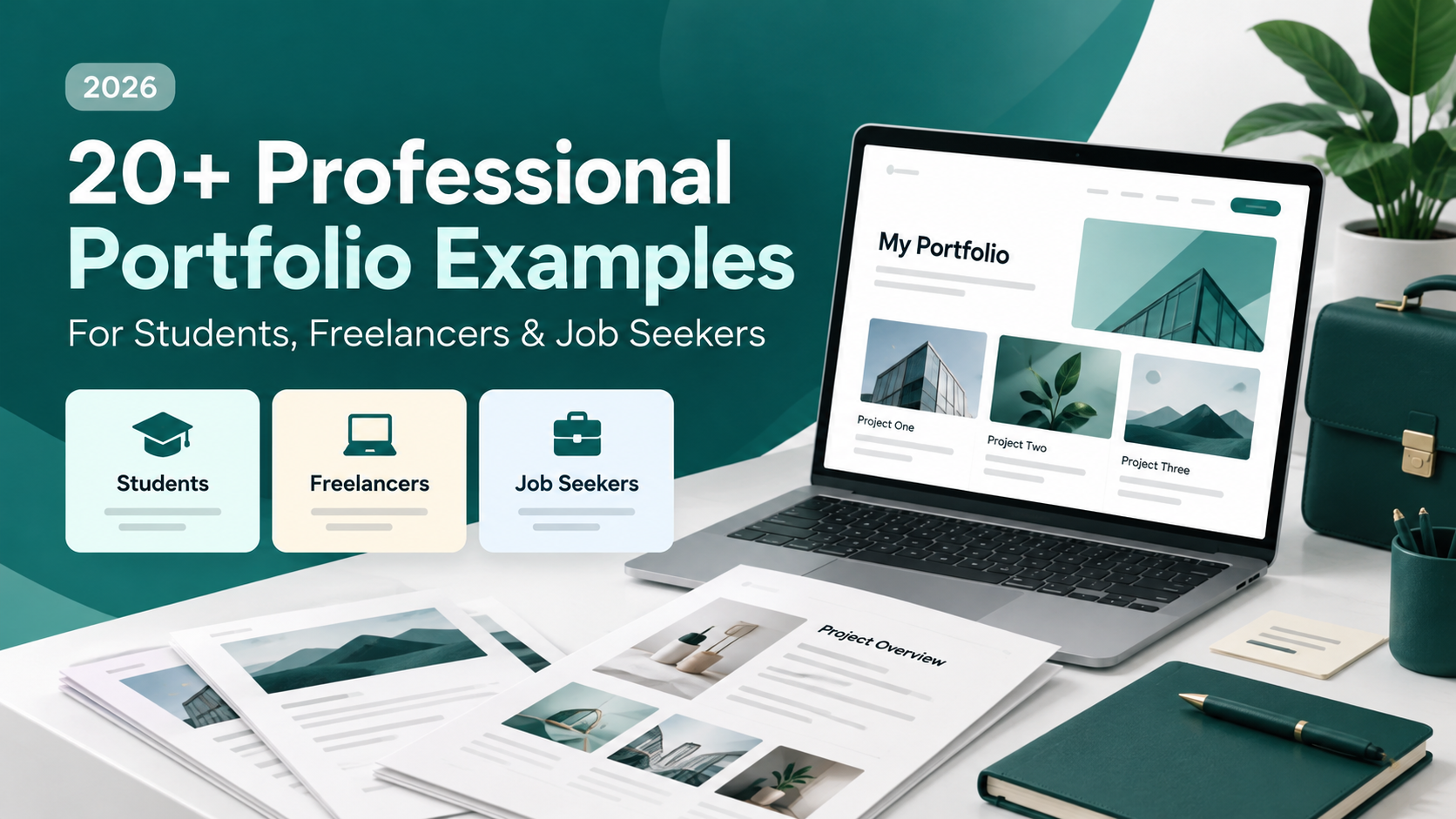
A great professional portfolio does more than display your work. It shows employers and potential clients what you can do, how you solve problems, and why your skills matter.
Whether you're a student applying for your first internship, a freelancer looking for clients, or an experienced professional exploring new opportunities, a well-organized portfolio can help you present your abilities with confidence.
But knowing what to include in a professional portfolio isn't always easy.
Should you feature university assignments? Can you create a portfolio without professional experience? What kind of projects will help potential employers understand your skills?
The good news is that you don't need years of work experience or an expensive website to build a useful portfolio.
In this guide, you'll discover:
- 25 professional portfolio examples across different careers
- Student portfolio examples for beginners and fresh graduates
- Freelancer portfolio ideas that demonstrate services and results
- Job portfolio examples for experienced professionals
- What to include in each type of portfolio
- Practical project descriptions you can adapt
- Common portfolio mistakes and how to avoid them
- How to create a professional online portfolio using CTRLin
By the end, you'll have a clearer idea of how to turn your projects, achievements, and experience into a portfolio that supports your career goals.
What Is a Professional Portfolio?
A professional portfolio is a curated collection of work samples, projects, achievements, and supporting evidence that demonstrates your skills and experience.
Unlike a resume, which summarizes your qualifications and work history, a portfolio gives employers or clients a closer look at the work you've completed.
For example, a software developer might include applications, GitHub repositories, and technical explanations. A graphic designer might showcase branding projects, while a marketing professional could present campaigns, content strategies, and performance results.
A strong portfolio usually answers three questions:
- What can you do? Your skills, expertise, and capabilities.
- How do you work? Your process, decisions, and problem-solving approach.
- What have you accomplished? Your completed work, outcomes, or learning.
A portfolio can take several forms, including a personal website, digital project gallery, PDF presentation, or collection of case studies.
For most people applying online, a shareable digital portfolio offers a convenient way to organize projects and make them accessible.
25 Professional Portfolio Examples by Career and Experience Level
The best professional portfolio examples are tailored to the person creating them.
A student's portfolio may focus on education and potential. A freelancer's portfolio should help prospective clients evaluate services. An experienced professional might emphasize business outcomes, leadership, and specialized expertise.
The following 25 examples are hypothetical models you can adapt using your own authentic work.
Part 1: Student Portfolio Examples
Students often believe they need professional experience before creating a portfolio. In reality, academic assignments, personal projects, volunteering, competitions, and independent learning can all provide relevant evidence of skills.
1. Computer Science Student Portfolio
Best for: Computer science students, aspiring software developers, and internship applicants.
A computer science portfolio should demonstrate technical abilities through working projects.
Example portfolio structure:
- Introduction: Computer Science Student | Aspiring Software Developer
- Technical skills: Python, JavaScript, React, SQL
- Project 1: Student Management System
- Project 2: Weather Forecast Application
- Project 3: Personal Expense Tracker
- GitHub repositories and live demonstrations
- Contact information
Sample project description:
"Developed a student management web application using React and Node.js, including student registration, record management, and search functionality."
What makes it effective: The portfolio demonstrates applied programming knowledge instead of listing programming languages alone.
Tip: Include a working demo, screenshots, setup instructions, and a description of your individual contribution.
2. Graphic Design Student Portfolio
Best for: Design students, junior graphic designers, and creative interns.
A graphic design portfolio should showcase visual communication, creativity, and design decisions.
Portfolio project ideas:
- Brand identity design
- Logo development
- Event posters
- Social media graphics
- Packaging concepts
- Typography experiments
Sample project:
"Created a visual identity concept for a fictional sustainable coffee brand, including logo exploration, packaging mockups, typography, and brand color guidelines."
Clearly label fictional briefs as concept work.
What makes it effective: The reviewer can see both the finished design and the reasoning behind it.
3. Business Administration Student Portfolio
Best for: Business students, management trainees, and entry-level business analysts.
Business students can demonstrate analytical thinking and communication through coursework and case studies.
Include examples such as:
- SWOT analysis
- Competitor research
- Business plans
- Market research presentations
- Financial analysis
- Strategic recommendations
Sample project:
"Conducted a market-entry analysis for a hypothetical retail business, examining competitors, customer segments, potential risks, and pricing opportunities."
What makes it effective: It demonstrates business judgment and structured analysis before formal employment.
4. Digital Marketing Student Portfolio
Best for: Marketing students and aspiring digital marketers.
Marketing portfolios can include both creative output and analytical evidence.
Portfolio examples:
- Social media content calendars
- SEO content briefs
- Email campaign concepts
- Audience personas
- Advertising mockups
- Campaign performance analysis
Sample project:
"Designed a 30-day social media campaign for a fictional skincare brand, including audience research, messaging, creative samples, and proposed performance indicators."
What makes it effective: It demonstrates how creative decisions connect to specific marketing goals.
Do not present estimated campaign results as actual performance.
5. Engineering Student Portfolio
Best for: Mechanical, electrical, civil, and electronics engineering students.
Engineering portfolios should highlight technical work, practical applications, and problem-solving processes.
Possible projects:
- Arduino-based automation
- CAD models
- Circuit simulations
- Robotics prototypes
- Energy efficiency studies
- Final-year engineering projects
Sample project:
"Designed and tested a prototype automatic irrigation system using an Arduino, soil moisture sensor, and relay-controlled water pump."
What makes it effective: It combines theoretical knowledge with practical implementation.
Include diagrams, testing procedures, design constraints, and results.
6. Data Analytics Student Portfolio
Best for: Statistics, business analytics, and data science students.
A data analytics portfolio should demonstrate how you transform raw data into useful insights.
Include:
- Excel dashboards
- SQL analysis
- Power BI reports
- Python notebooks
- Data cleaning projects
- Visual storytelling
Sample project:
"Analyzed a public retail dataset to identify seasonal sales patterns and created an interactive dashboard for exploring product categories and regional performance."
What makes it effective: It reveals both technical capability and the ability to explain findings.
Include dataset sources and methodology so readers can evaluate the work.
7. Content Writing Student Portfolio
Best for: Journalism, English, communication, and content marketing students.
A writing portfolio should show range, clarity, and audience awareness.
Portfolio content ideas:
- Blog posts
- Opinion articles
- Product descriptions
- Newsletter samples
- Interviews
- Academic writing samples
Sample project:
"Wrote a beginner-friendly article explaining how university students can prepare for their first internship, using a practical structure and actionable examples."
What makes it effective: Potential employers can assess writing quality directly.
Include polished samples rather than unfinished drafts.
8. Student Portfolio with No Work Experience
Best for: High school students, first-year university students, and complete beginners.
If you have no professional experience, focus on what you have learned, created, and contributed.
Simple portfolio layout:
- About Me
- Education
- Skills
- Two or three academic or personal projects
- Certifications
- Volunteer activities
- Career goals
- Contact information
Example introduction:
"I'm a business student interested in digital marketing and customer research. Through academic projects and independent learning, I've developed skills in market analysis, content planning, and presentation design."
What makes it effective: It demonstrates direction and initiative without exaggerating experience.
Part 2: Freelancer Portfolio Examples
Freelancers need portfolios that make it easy for potential clients to understand their services, review their work, and decide whether to make contact.
A strong freelancer portfolio combines work samples with clear service descriptions, project context, and trustworthy results.
9. Freelance Web Developer Portfolio
Best for: Frontend developers, full-stack developers, and independent website creators.
Include:
- E-commerce websites
- Business landing pages
- Web applications
- Responsive layouts
- Performance improvements
- Technical case studies
Sample project:
"Developed a responsive business website using Next.js, with service pages, reusable components, and optimized image loading."
Recommended presentation: Show screenshots, a live preview, technologies used, and major development decisions.
What makes it effective: Clients can evaluate both the functionality and quality of delivered websites.
10. Freelance Graphic Designer Portfolio
Best for: Logo designers, brand identity specialists, and social media designers.
Portfolio sections:
- Logo design
- Brand identity
- Social media creatives
- Packaging
- Print design
- Selected client projects
Sample project:
"Created a visual identity for a local clothing brand, including logo variations, brand colors, typography, and social media templates."
What makes it effective: It shows consistent branding across multiple deliverables.
Use approved client assets and clearly distinguish commissioned work from self-initiated concepts.
11. Freelance Content Writer Portfolio
Best for: SEO writers, blog writers, technical writers, and copywriters.
Include writing samples such as:
- SEO blog posts
- Website copy
- Landing page content
- Product descriptions
- Email newsletters
- Long-form guides
Sample project:
"Developed a detailed beginner's guide to personal budgeting, including keyword research, content structure, original examples, and practical recommendations."
What makes it effective: Clients can evaluate subject knowledge, writing style, and content organization.
Add published links where permissions allow.
12. Freelance Digital Marketer Portfolio
Best for: SEO specialists, paid advertising freelancers, and growth marketers.
Portfolio project examples:
- SEO audits
- Organic content strategies
- Paid advertising campaigns
- Conversion optimization experiments
- Email marketing campaigns
- Analytics dashboards
Sample project:
"Audited a small business website, identifying technical SEO issues, missing metadata, weak internal links, and content opportunities."
What makes it effective: It connects marketing activities to business problems and documented recommendations.
Where genuine data is available, show verified before-and-after metrics with context.
13. Freelance UI/UX Designer Portfolio
Best for: Product designers, UX researchers, and interface designers.
Include:
- User research
- Wireframes
- User journeys
- Figma prototypes
- Usability testing
- Before-and-after designs
Sample project:
"Redesigned the checkout flow of a fictional online store to address confusing navigation and unnecessary form fields."
What makes it effective: The case study explains the design process, not just the finished interface.
Avoid inventing usability-test results. If a design was not tested, explain what you would test next.
14. Freelance Video Editor Portfolio
Best for: YouTube editors, short-form content editors, and motion graphics specialists.
Showcase:
- Promotional videos
- Social media reels
- YouTube introductions
- Product demonstrations
- Motion graphic samples
- Before-and-after edits
Sample project:
"Edited a product demonstration video with motion graphics, captions, transitions, and audio improvements to create a concise promotional asset."
What makes it effective: A short demo reel helps prospective clients assess pacing, storytelling, and editing quality.
15. Freelance Virtual Assistant Portfolio
Best for: Administrative freelancers, remote assistants, and operations support professionals.
A virtual assistant portfolio may include:
- Workflow documentation
- Calendar management systems
- Spreadsheet templates
- Project trackers
- Research summaries
- Email organization examples
Sample project:
"Designed a project-tracking spreadsheet with task ownership, priority levels, deadlines, and progress indicators for a simulated remote team."
What makes it effective: It turns organizational skills into tangible work samples.
Always replace confidential business data with fictional information.
16. Freelance Photographer Portfolio
Best for: Event photographers, portrait photographers, and commercial photographers.
Portfolio categories:
- Portrait photography
- Product photography
- Events
- Lifestyle photography
- Editing and retouching
- Client galleries
Sample project:
"Produced a collection of product photographs for a handmade accessories concept, using controlled lighting and consistent styling."
What makes it effective: The visual presentation demonstrates both technical quality and artistic direction.
Choose a small collection of strong images rather than uploading every photograph.
Part 3: Professional Portfolio Examples for Job Seekers
Experienced job seekers should focus on projects that reflect the responsibilities and skills required for their target roles.
Results, professional judgment, and personal contributions usually matter more than decorative presentation.
17. Software Engineer Portfolio
Best for: Frontend, backend, and full-stack engineers.
Portfolio content:
- Production projects where sharing is permitted
- Open-source contributions
- API integrations
- System design examples
- Technical problem-solving
- Testing and performance improvements
Sample project:
"Designed and implemented a reusable component library to improve consistency across internal web applications."
What makes it effective: It showcases engineering decisions and maintainability rather than simply listing frameworks.
Describe the problem, architecture, tradeoffs, testing, and your individual role.
18. Project Manager Portfolio
Best for: Project coordinators, product delivery managers, and project managers.
Include:
- Project plans
- Milestone trackers
- Stakeholder communication
- Risk registers
- Resource planning
- Project outcome summaries
Sample project:
"Coordinated a cross-functional website migration, tracking milestones, identifying dependencies, and organizing stakeholder updates."
What makes it effective: It provides evidence of planning, coordination, and delivery skills.
Use redacted documents or recreated examples where projects involve confidential information.
19. Marketing Manager Portfolio
Best for: Marketing managers, brand strategists, and campaign leads.
Recommended case studies:
- Campaign strategy
- Brand positioning
- Customer segmentation
- Content planning
- Conversion optimization
- Performance reporting
Sample project:
"Developed a multi-channel campaign strategy for a product launch, aligning audience segmentation, promotional messaging, creative assets, and reporting."
What makes it effective: It demonstrates strategic thinking and cross-channel coordination.
Show outcomes only when you can substantiate them.
20. Teacher or Educator Portfolio
Best for: Teachers, trainers, academic professionals, and instructional designers.
Include:
- Teaching philosophy
- Lesson plans
- Curriculum examples
- Learning activities
- Assessment methods
- Professional development
- Student feedback summaries, where appropriate
Sample project:
"Developed an interactive science lesson using hands-on demonstrations, formative assessment questions, and differentiated activities."
What makes it effective: It demonstrates instructional planning and student-centered teaching.
Protect student identities and obtain appropriate permission before sharing classroom material.
21. Data Analyst Professional Portfolio
Best for: Data analysts, business intelligence professionals, and reporting specialists.
Project ideas:
- Business performance dashboards
- Customer segmentation analysis
- Forecasting models
- Data visualization
- Process automation
- Operational reporting
Sample project:
"Created an operational reporting dashboard that consolidated project delivery data and highlighted delays, resource utilization, and recurring workflow issues."
What makes it effective: It shows how analytical work can support business decisions.
Explain the dataset, cleaning process, analytical method, and limitations.
22. Product Manager Portfolio
Best for: Associate product managers, product owners, and experienced product managers.
Include:
- Product problem statements
- Market research
- Feature prioritization
- Roadmap examples
- User stories
- Experiment designs
- Product launch retrospectives
Sample project:
"Created a feature prioritization framework for a SaaS product concept, evaluating user needs, development effort, and expected business value."
What makes it effective: It showcases product reasoning and decision-making.
Use sanitized project information rather than revealing private roadmaps.
23. Career Changer Portfolio
Best for: Professionals moving into technology, marketing, design, or another industry.
A career change portfolio should connect previous experience to newly developed skills.
Example: Teacher transitioning into UX design
- Previous strength: Understanding user needs and communicating clearly
- New skills: User research, Figma, prototyping
- Project 1: Learning management dashboard redesign
- Project 2: Mobile learning experience concept
- Project 3: Accessibility review of an educational website
Sample introduction:
"After working in education, I developed a strong interest in user experience design. My portfolio combines learner-centered problem-solving with newly developed skills in research, wireframing, and interface design."
What makes it effective: It positions past experience as a transferable advantage.
24. Human Resources Professional Portfolio
Best for: HR specialists, recruiters, and learning and development professionals.
Portfolio examples:
- Employee onboarding frameworks
- Recruitment process maps
- Training presentations
- Performance review templates
- Workforce analytics
- Employee engagement initiatives
Sample project:
"Developed a structured onboarding framework with role-specific checklists, introductory training, and manager feedback milestones."
What makes it effective: It demonstrates operational improvement and people-process expertise.
Never include identifiable employee records or confidential candidate information.
25. Business Consultant Portfolio
Best for: Business consultants, strategy professionals, and independent advisors.
Include:
- Business diagnostics
- Market assessments
- Operational improvement plans
- Financial models
- Process maps
- Strategic recommendations
Sample project:
"Conducted an operational assessment for a hypothetical service business, mapped process bottlenecks, and proposed workflow improvements."
What makes it effective: Prospective clients can understand how the consultant evaluates problems and produces recommendations.
A concise case study is generally more useful than a long collection of generic business slides.
Professional Portfolio Examples: Quick Comparison
| Portfolio Type Best Projects to Showcase Most Useful Evidence | ||
| Student | Academic and personal projects | Assignments, prototypes, certifications |
| Fresh Graduate | Internships and final-year projects | Deliverables, research, demonstrations |
| Freelancer | Client work and service examples | Approved samples, testimonials, outcomes |
| Software Developer | Applications and technical projects | Live demos, code, technical decisions |
| Designer | Branding and interface projects | Visuals, case studies, design rationale |
| Marketer | Campaigns and content projects | Analytics, creative samples, strategy |
| Data Analyst | Dashboards and data investigations | Data sources, methodology, findings |
| Career Changer | Transferable and new-skill projects | Relevant case studies, learning evidence |
| Experienced Professional | Major work achievements | Leadership, documented impact, deliverables |
The right portfolio is not necessarily the one with the most projects. It is the one that makes your most relevant abilities easy to evaluate.
What Should a Professional Portfolio Include?
Although individual portfolios vary, most benefit from a consistent set of essential sections.
1. Professional Introduction
Explain who you are, what you do, and the opportunities you're seeking.
Example:
"I'm a frontend developer specializing in accessible and responsive websites. I work with React, Next.js, and modern CSS to build practical digital experiences."
Avoid vague statements such as "I'm hardworking, passionate, and motivated" without offering evidence.
2. About Me Section
Provide a short overview of your background, interests, and relevant experience.
Focus on information that helps visitors understand your professional direction.
3. Skills and Expertise
Organize your skills around your target role.
A developer might separate programming languages, frameworks, and testing tools. A marketer might list SEO, campaign planning, content strategy, and analytics.
4. Selected Projects
Choose approximately three to five strong, relevant projects as a starting point.
For each project, include:
- Project title
- Context or problem
- Your specific role
- Tools and methods
- Key actions or design decisions
- Final deliverable
- Verified results or lessons learned
- A link or visual sample, where possible
5. Experience and Education
Add relevant employment, internships, education, and certifications.
Students may emphasize education and projects. Experienced professionals may give greater space to achievements and selected roles.
6. Achievements and Testimonials
Include awards, certifications, client testimonials, or measurable results when you have permission and can verify them.
Avoid fabricated testimonials or unsupported numbers.
7. Contact Information
Make it easy to connect.
Include an appropriate email address and relevant professional links such as LinkedIn, GitHub, or other work platforms.
How to Write a Portfolio Project Description
A strong portfolio should explain more than the name of a project.
Use this reusable structure:
Project title: [Name of project]
Project type: [Academic / Personal / Freelance / Professional]
Objective: [What problem did the project address?]
My role: [What was I responsible for?]
Tools and skills: [Which technologies, methods, or abilities did I use?]
Process: [What important steps or decisions did I make?]
Outcome: [What did I create, accomplish, or learn?]
Evidence: [Link, screenshot, document, demo, or supporting artifact]
Example: E-commerce Website
Project: Responsive E-commerce Website
Project type: Personal project
Objective: Create a responsive shopping experience for a fictional retail brand.
My role: Frontend Developer
Tools: React, JavaScript, CSS
Process: Designed reusable product cards, implemented category filtering, and built responsive navigation for different screen sizes.
Outcome: Completed a functional frontend demonstration with product browsing and cart interactions.
Evidence: GitHub repository, live demonstration, and mobile screenshots.
This format helps employers understand not only what the project looks like but also how you approached the work.
How to Build a Professional Online Portfolio with CTRLin
Once you've selected your best projects, the next step is to organize them into a clear and accessible portfolio.
CTRLin provides a way to build and present your professional profile, resume, and portfolio together.
Step 1: Identify Your Goal
Decide whether you're creating your portfolio for:
- Internship applications
- Full-time job opportunities
- Freelance clients
- Career transitions
- Professional networking
Your goal influences which projects and skills you should emphasize.
Step 2: Prepare Your Portfolio Content
Collect your professional summary, skills, education, experience, and project information.
Use authentic examples and make sure supporting files or links are accessible.
Step 3: Create Your Portfolio on CTRLin
Visit CTRLin and use its portfolio creation tools to organize your professional information.
Choose a clear structure that helps visitors move easily between your introduction, projects, skills, and contact information.
Step 4: Add Your Strongest Projects
Start with your most relevant work.
Use descriptive project titles, concise explanations, and supporting visuals or links.
Remember to explain your individual contribution, especially in group projects.
Step 5: Review Your Portfolio
Before sharing it, check that:
- Project descriptions are accurate
- Links work correctly
- Spelling and grammar are correct
- Images and documents display properly
- Contact details are current
- No confidential information is exposed
- The portfolio is readable on mobile devices
Step 6: Share It with Employers or Clients
Add your portfolio link to your resume, LinkedIn profile, job applications, and professional email signature where appropriate.
Keep your professional information consistent across these platforms.
Ready to showcase your work? Visit CTRLin and build a professional portfolio that brings your skills, projects, and career achievements together.
8 Common Portfolio Mistakes to Avoid
Even strong work can be difficult to evaluate when a portfolio is poorly organized.
1. Including Every Project
More is not always better. Select relevant projects that reflect your strongest capabilities.
2. Showing Only Images
Screenshots are useful, but they rarely explain your goals, contributions, or decisions.
Add project context and outcomes.
3. Using Generic Descriptions
A statement such as "Created a website" tells the reader very little.
Explain what you built, who it was for, and what made the project challenging or useful.
4. Copying Projects Without Adding Original Work
Tutorial projects can help demonstrate learning, but give credit where appropriate and explain what you independently changed or improved.
5. Publishing Unsupported Results
Avoid invented claims about sales growth, performance improvements, or client satisfaction.
When results are unavailable, explain what you delivered and what you learned.
6. Ignoring Mobile Visitors
Make sure text, images, buttons, and navigation remain usable on smaller screens.
7. Sharing Confidential Work
Remove private client data, internal company information, and personal records before publishing samples.
Request permission when necessary.
8. Forgetting to Update the Portfolio
Review your portfolio after completing meaningful projects, gaining new skills, or changing career direction.
An up-to-date portfolio is more useful than one filled with outdated examples.
Professional Portfolio Checklist
Before sharing your portfolio, confirm that you have completed the following:
- Clear professional headline
- Short and relevant introduction
- Skills aligned with your target opportunity
- Three to five strong projects, where available
- Accurate descriptions of your individual contributions
- Screenshots, demos, or other supporting evidence
- Verified achievements and results
- Education or professional experience
- Current contact details
- Working project links
- Mobile-friendly presentation
- Appropriate permission for shared client material
- Consistent information across portfolio and resume
You do not need every section to be extensive. The goal is to provide enough credible information for someone to understand your abilities.
Frequently Asked Questions
1. What are some good professional portfolio examples?
Good professional portfolio examples include software development projects, graphic design case studies, marketing campaigns, data dashboards, writing samples, engineering prototypes, and business analysis projects. The best examples match the opportunities you're pursuing.
2. How do students create portfolios without experience?
Students can use academic assignments, personal projects, competitions, volunteer work, and relevant certifications. Each project should explain the student's contribution, skills applied, and outcome or learning.
3. How many projects should a professional portfolio include?
Three to five strong projects are a practical starting point for many portfolios. Beginners may start with fewer, while experienced professionals may need a larger collection organized by specialization.
4. Can I create a portfolio without having a job?
Yes. Personal projects, academic work, simulations, and volunteering can demonstrate practical abilities. Just label the work accurately rather than presenting it as paid employment.
5. What is the difference between a resume and a portfolio?
A resume summarizes your qualifications, skills, experience, and achievements. A portfolio provides more detailed examples or evidence of your work. Depending on the role, the two can complement each other.
6. What should freelancers include in their portfolios?
Freelancers should include their services, relevant work samples, brief case studies, verified results when available, testimonials with permission, and clear contact information.
7. Is an online portfolio better than a PDF portfolio?
An online portfolio is easy to update and share through a link. A PDF can be useful when an employer requests a fixed document or when presenting selected work offline. The best format depends on your industry and the application requirements.
8. Do recruiters look at portfolio websites?
Some recruiters and hiring managers review portfolios, particularly for creative, technical, and project-based roles. Whether a portfolio is requested or reviewed depends on the employer and position.
9. Can I include AI-generated projects in my portfolio?
You can include AI-assisted work when permitted and relevant, but be transparent about how AI was used. Clearly describe your original contribution, the tools involved, and what you independently created, evaluated, or improved.
10. How can I make my portfolio stand out?
Focus on relevant projects, a clear professional identity, genuine supporting evidence, and concise case studies. Make it easy for visitors to understand your work and contact you.
Final Thoughts: Your Work Deserves to Be Seen
A professional portfolio is not just a collection of attractive pages. It is a practical way to demonstrate what you have learned, created, solved, and achieved.
Students can use portfolios to show potential before gaining professional experience. Freelancers can present their services and build trust with prospective clients. Job seekers can provide stronger evidence of their qualifications and achievements.
The most effective portfolio is not necessarily the most elaborate. It is clear, relevant, credible, and easy to explore.
Start with your strongest project. Explain what you did. Add another when you have something meaningful to show.
Over time, your portfolio can become a valuable record of your professional growth.
Want to turn your work into a professional portfolio? Explore CTRLin to organize your projects, highlight your skills, and present your career story in one place.
Get Exclusive Updates & Resume Builder Features
Subscribe to our newsletter and stay ahead with the newest tools, design updates, and job-winning tips.