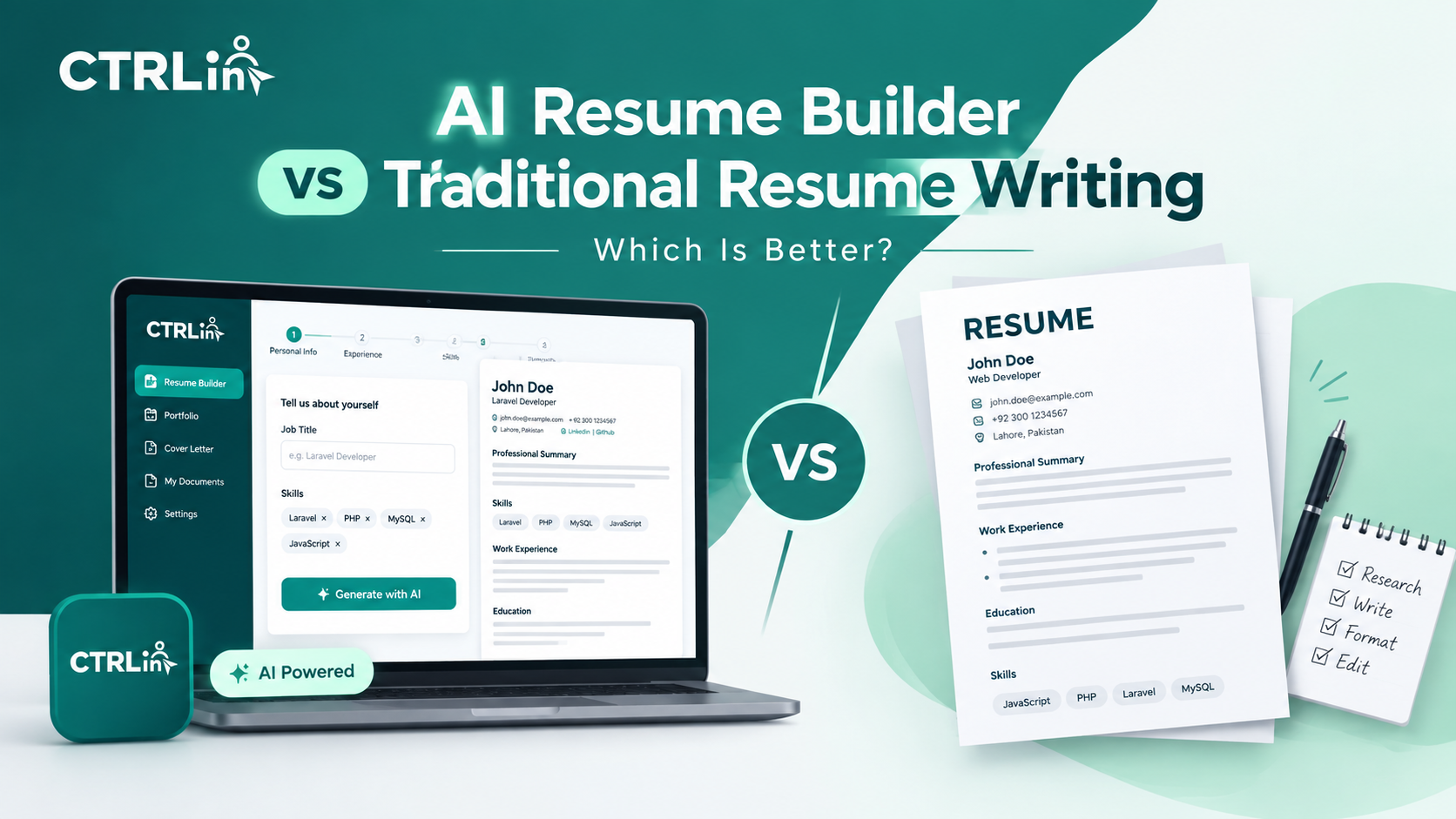
AI Resume Builder vs Traditional Resume Writing: Which Is Better?
12 Sept 2026 · CTRLin
Writing a resume used to mean opening a blank Word document, finding a template, and spending hours trying to figure out what belongs on the page.
Today, there is another option. AI-powered resume builders can help you create a resume by guiding you through the process, suggesting content, improving wording, and organizing your information into a professional format.
So which approach is actually better?
The answer depends on what you need.
If you enjoy writing and already know how to structure a resume, doing everything manually can work well. If you're starting from scratch or want to save time, an AI resume builder can make the process much easier.
Let's compare both approaches and look at where each one makes sense.
What Is an AI Resume Builder?
An AI resume builder is an online tool that helps you create or improve a resume using artificial intelligence and guided resume-building features.
Instead of starting with a completely blank page, you typically provide information about your education, work experience, skills, projects, and career goals.
The tool can then help with things such as:
- Writing or improving resume descriptions
- Organizing different resume sections
- Suggesting professional wording
- Highlighting relevant skills
- Formatting the resume
- Creating a professional-looking layout
- Adapting content for different types of jobs
Some tools also offer features such as cover letter creation, portfolio building, or professional profiles.
The important thing to remember is that AI should help you present your experience better. It shouldn't invent experience that you don't have.
What Is Traditional Resume Writing?
Traditional resume writing generally means creating your resume yourself without AI assistance.
You might use Microsoft Word, Google Docs, a downloadable template, or another document editor.
You decide:
- What information to include
- How to describe your experience
- Which skills to highlight
- How to structure the document
- Which template to use
- How to format the final version
Another form of traditional resume writing is hiring a professional resume writer. In that case, a human reviews your background and creates or improves the resume for you.
So when comparing “AI vs traditional,” there are actually two common traditional approaches:
DIY resume writing: You do everything yourself.
Professional resume writing: A human resume writer does most of the writing and editing.
Both have advantages, but they also have limitations.
AI Resume Builder vs Traditional Resume Writing
Here's a quick comparison:
| FactorAI Resume BuilderTraditional Resume Writing | ||
| Speed | Usually faster | Can take longer |
| Cost | Often affordable | Can be expensive if using a professional writer |
| Formatting | Usually built into the tool | You handle formatting yourself |
| Writing assistance | AI suggestions and improvements | You write it yourself or work with a professional |
| Customization | Depends on the tool | High if you do it yourself |
| Ease of use | Generally beginner-friendly | Can have a learning curve |
| Revisions | Usually quick | Can take additional time |
| Human judgment | Limited | Strong with a professional writer |
| Control | Depends on the platform | Full control when writing yourself |
| Multiple versions | Easy to create with the right tool | More manual work |
But the table doesn't tell the whole story.
1. Time: AI Has the Advantage
One of the biggest reasons people use AI resume builders is simple: they don't want to spend an entire evening formatting a resume.
With traditional resume writing, you may spend time deciding:
- Which template to use
- How to organize sections
- How to write your summary
- How to describe previous jobs
- How to format dates
- How to fit everything onto one or two pages
Then you may have to repeat the process when you find another job you'd like to apply for.
An AI resume builder can reduce much of this manual work.
You still need to provide accurate information, but the tool can help turn that information into a structured resume.
For someone applying to several jobs, that time savings can be significant.
2. Writing: AI Can Help When You Don't Know What to Say
Writing about yourself is surprisingly difficult.
You may know exactly what you did at your previous job, but turning that into a strong resume bullet can be another matter.
For example, you might write:
Worked on company website.
That's technically correct, but it doesn't tell the recruiter much.
A resume builder may help you turn it into something more specific, such as:
Developed and maintained company website features using Laravel, PHP, and MySQL.
The important part is that the information still needs to come from you.
AI can improve the presentation, but you should review every suggestion and make sure it accurately represents your experience.
3. Formatting: Traditional Writing Requires More Work
Formatting sounds easy until you've spent 30 minutes trying to move one section to the next page.
Traditional resume writing often involves adjusting:
- Margins
- Font sizes
- Line spacing
- Section headings
- Bullet points
- Page breaks
- Alignment
A small change near the top of a resume can sometimes affect the entire document.
Most resume builders handle much of this automatically.
You choose a layout, enter your information, and the platform takes care of much of the visual structure.
This can be particularly helpful if you're not comfortable with document formatting.
4. Cost: It Depends on the Approach
Traditional resume writing can cost nothing if you create the resume yourself using Word or Google Docs.
However, professional resume writers can charge significantly more because you're paying for their time and expertise.
AI resume builders usually sit somewhere between these approaches.
Some offer free features, while others charge for premium templates, AI features, downloads, or additional career tools.
Before paying for any service, check exactly what is included.
A cheap resume builder that produces a resume you cannot customize may not be useful. Likewise, paying a large amount for a professional writer may not make sense if you only need help with formatting.
5. Customization: Traditional DIY Writing Gives You More Direct Control
If you create your resume manually, you control every word and every design decision.
That's useful if you already understand resume structure and know exactly what you want.
AI tools can also provide customization, but the amount varies from one platform to another.
Some tools allow you to edit everything. Others are more restrictive.
Before choosing an AI resume builder, check whether you can easily change the content, sections, formatting, and template.
6. Personalization: Neither Approach Automatically Guarantees It
This is an important point.
An AI-generated resume isn't automatically personalized.
If you enter generic information and accept every AI suggestion without reviewing it, your resume can still sound generic.
The same problem exists with traditional writing.
You can write a resume yourself and send the exact same version to 100 companies.
The better approach is to tailor your resume to the role.
Look at the job description and consider:
- Which skills does the employer mention?
- Which responsibilities match your experience?
- Which projects are most relevant?
- Which achievements should receive more attention?
- Is your professional summary appropriate for the position?
Whether AI helps you or not, personalization still requires your judgment.
Can an AI Resume Builder Replace a Professional Resume Writer?
Not completely.
AI is good at many practical tasks. It can help organize information, improve wording, generate suggestions, and speed up the resume-building process.
A professional resume writer brings something different: human judgment.
A good writer can ask questions about your career, identify strengths you may have overlooked, understand your career direction, and decide which experiences deserve the most attention.
For someone with a complicated career history, executive experience, a major career change, or a very specific job target, working with an experienced professional may still be worthwhile.
For many students, fresh graduates, developers, designers, and other professionals who simply need a strong, well-organized resume, an AI-assisted builder may be enough.
Are AI-Generated Resumes Good for ATS?
An important misconception is that simply using AI makes a resume ATS-friendly.
It doesn't.
An Applicant Tracking System (ATS) is software employers may use to process and organize applications.
A resume still needs appropriate structure, readable formatting, relevant terminology, and accurate information.
AI can help you identify and incorporate relevant skills or keywords, but you shouldn't simply copy every keyword from a job description into your resume.
For example, if a job asks for experience with Laravel, MySQL, REST APIs, and Git, and you genuinely have those skills, make sure they are clearly represented.
But if you have never used Kubernetes, adding “Kubernetes” just because it appears in the job description isn't a good strategy.
Accuracy matters.
What About AI Resume Builders for Fresh Graduates?
AI tools can be particularly useful for people creating their first resume.
Fresh graduates often face the same problem:
“I don't have enough work experience. What am I supposed to put on my resume?”
An AI-assisted builder can help identify useful sections and organize things such as:
- University projects
- Internships
- Coursework
- Certifications
- Technical skills
- Volunteer experience
- Academic achievements
- Personal projects
For example, a computer science graduate may not have worked as a software developer yet, but a university project involving Laravel and MySQL can still demonstrate practical skills.
The resume should focus on what the person has actually done rather than trying to make them appear more experienced than they are.
When Traditional Resume Writing May Be Better
An AI resume builder isn't the right answer for everyone.
Traditional writing may be better if:
You Already Know How to Write Resumes
If you've written several successful resumes and understand what recruiters in your industry expect, you may not need much assistance.
You Want Complete Control
Some people simply prefer writing and formatting everything themselves.
There's nothing wrong with that.
Your Career Requires Significant Personal Context
Senior executives, career changers, consultants, and professionals with unusual career histories may benefit from having a human carefully review their story.
You Prefer Human Feedback
AI can provide suggestions, but it doesn't replace a conversation with someone who can challenge your assumptions and ask follow-up questions about your career.
When an AI Resume Builder Makes More Sense
An AI-assisted approach can be a good option when:
- You're creating your first resume
- You don't know how to structure a resume
- You struggle with professional wording
- You want to save time
- You need multiple versions of your resume
- You're applying for different types of positions
- You want help organizing your projects and achievements
- You want a professional layout without spending hours formatting it
For many job seekers, the biggest benefit isn't that AI “writes the perfect resume.”
It's that AI makes the process easier to start and easier to improve.
The Best Approach May Be a Combination of Both
You don't necessarily have to choose one side.
A practical approach is to combine technology with your own judgment.
Start by collecting your real information:
- Employment history
- Education
- Skills
- Projects
- Certifications
- Achievements
- Links
- Career goals
Use an AI resume builder to help organize and improve that information.
Then take the time to review the result yourself.
Remove anything that sounds unnatural.
Correct anything that isn't accurate.
Add details the AI wouldn't know.
Tailor the resume to the job you're applying for.
This gives you the speed of AI without handing over complete control of your professional story.
AI Resume Builder vs Traditional Resume Writing: Which Should You Choose?
There isn't one answer for everyone.
If you enjoy writing and formatting documents, traditional resume writing can work perfectly well.
If you want professional human guidance and have a complicated career story, a professional resume writer may be worth considering.
But if you want to create a professional resume quickly, need help with wording and structure, or are applying for multiple positions, an AI resume builder can be a practical option.
The technology is there to save you time. Your job is to make sure the final resume still sounds like you.
Final Thoughts
A resume is more than a document.
It's a short introduction to your professional experience, skills, and potential.
Whether you create it in Word, work with a professional writer, or use an AI resume builder, the same principle applies: the information needs to be truthful, relevant, and easy to understand.
AI can make resume writing faster. Traditional writing gives you complete control. A professional writer can add human perspective.
For many people, the most effective solution is somewhere in the middle: use AI to handle the repetitive work, then use your own judgment to make the resume personal and accurate.
That's what makes a resume useful—not whether it was created by AI or written entirely by hand.
Get Exclusive Updates & Resume Builder Features
Subscribe to our newsletter and stay ahead with the newest tools, design updates, and job-winning tips.