How Long Should a Resume Be? A Practical Guide for Every Career Stage
27 Jul 2026 · CTRLin
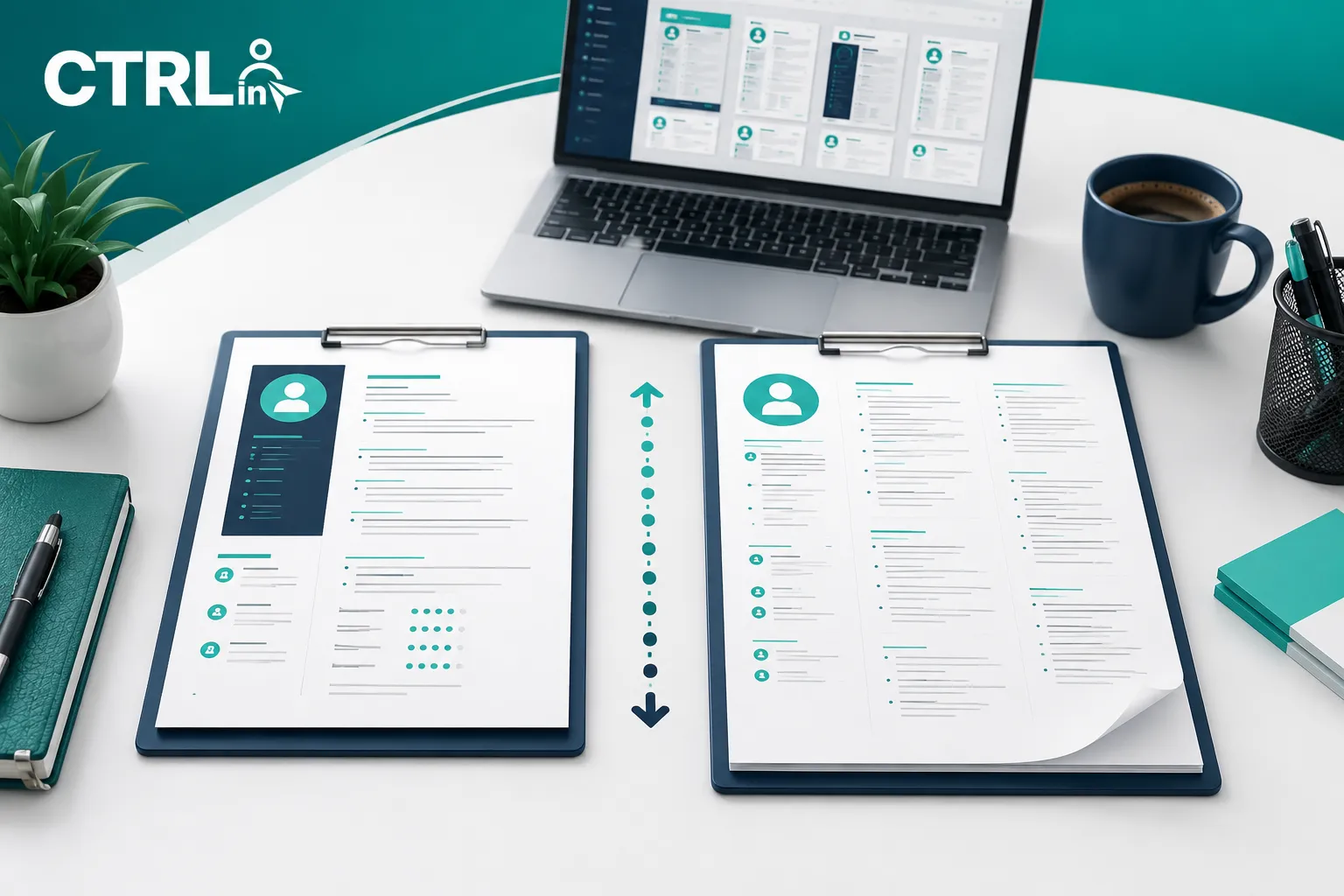
How long should my resume be?
This is one of the first questions job seekers ask and one of the most poorly answered. The old advice of "always one page" is a rule of thumb that stopped being true decades ago.
The honest answer is that resume length depends on three things: how much experience you have, what industry you work in, and what role you're targeting. Recruiters spend roughly six to eight seconds on the first pass through a resume, so the real goal isn't hitting a page count. It's making sure that every line earns its place.
This guide breaks down what length makes sense at each career stage, what to cut when you're running long, and which common assumptions about resume length are simply wrong.
The Short Answer
| Experience level Recommended length | |
| 0–5 years | 1 page |
| 5–15 years | 2 pages |
| 15+ years or executive roles | 2–3 pages, only when justified |
Treat these as guardrails, not targets. A well-edited one-page resume beats a padded two-page one every time.
When One Page Is the Right Call
A single page is the standard for:
- Students and recent graduates
- Entry-level professionals
- Career changers with limited directly relevant experience
- Anyone with fewer than five years in the workforce
Why It Works
Recruiters don't expect an extensive work history from early career candidates, and padding one signals inexperience rather than hiding it. What they're actually looking for is evidence of potential and preparation:
- Education
- Internships
- Relevant coursework and projects
- Technical skills
- Certifications
- Volunteer or leadership experience
One page forces you to lead with your strongest material. If you have a bachelor's degree and two employers behind you, a second page will almost certainly dilute rather than strengthen your case.
When Two Pages Make Sense
Two pages is the working standard for experienced professionals, and there's no penalty for using the space when you've earned it. Go to two pages if you have:
- Five to fifteen years of experience
- Several relevant positions showing progression
- Leadership or management responsibility
- Measurable achievements worth detailing
- Certifications or specialized technical expertise
- Substantial projects tied to your target role
A second page lets you show a career trajectory instead of compressing a decade into six-point font. Structure it around the sections that carry weight: professional summary, work experience, skills, certifications, education, and — where relevant — awards and key projects.
One caution: a second page is permission, not an obligation. If your material fills a page and a half, leave it at a page and a half. Padding to fill white space is transparent to anyone who reads resumes for a living.
Is Three Pages Ever Acceptable?
Occasionally, yes — but the bar is high. Three pages can be appropriate for:
- Senior executives and directors
- Researchers, professors, and scientists
- Medical professionals
- Federal and government applications, which often require detail that private-sector resumes omit
- Specialists with twenty-plus years of highly relevant experience
Even in these cases, the third page has to justify itself. Roles from early in your career rarely need full bullet treatment, summarize them in a compact "Earlier Career" block instead.
Academic CVs are a separate category with different conventions publications, grants, teaching, and conference history are expected, and no page limit applies.
Resume Length by Career Stage
| Career stage Recommended length | |
| Student | 1 page |
| Recent graduate | 1 page |
| Entry-level | 1 page |
| Mid-level professional | 1–2 pages |
| Senior professional | 2 pages |
| Executive | 2–3 pages |
| Academic CV | No page limit |
Relevance Beats Volume
There's a persistent instinct to treat length as a proxy for experience more pages, more credibility. In practice, the opposite reads true. A longer resume usually signals that the candidate couldn't decide what mattered.
What recruiters actually weigh:
- Achievements relevant to the open role
- Measurable results rather than listed duties
- Clean, consistent formatting
- Scannability
- Keywords that match the job description
A tight, achievement-focused resume will outperform a comprehensive one nearly every time.
What to Cut First
When your resume runs long, these are the safest things to remove:
Objective statements. Replace them with a professional summary that says what you offer rather than what you want.
Unrelated positions. Keep what supports your candidacy for this specific role.
Detail on older roles. Fifteen years in, your first job doesn't need four bullet points. A single line with title, employer, and dates is enough.
"References available upon request." Employers will ask. The line only consumes space.
Personal details. Marital status, religion, age, nationality, and photos don't belong on a resume in most markets, and in some they invite bias claims. Omit them unless the employer specifically requests them.
How Far Back Should You Go?
The working rule is ten to fifteen years of relevant experience in full detail. Anything older can be condensed:
Earlier Career Software Engineer, ABC Technologies (2006–2010)
No bullet points required unless that role speaks directly to the job you're pursuing.
The ATS Myth
A widespread belief holds that applicant tracking systems favor one-page resumes and discard longer ones. They don't. ATS software parses and ranks resumes on content and structure, not page count:
- Keyword and skill matches
- Job titles and dates
- Experience relevance
- Parseable formatting
What actually causes ATS problems is formatting, not length text buried in images or headers, unusual fonts, multi-column layouts that scramble on parse, and non-standard section headings. Use clear headings, standard fonts, consistent date formats, and the file type the employer asks for (usually PDF or DOCX).
Four Habits That Keep Length Under Control
Front-load recent work. Your last two roles should occupy the most space earlier ones taper.
Quantify outcomes. "Managed a sales team" tells a recruiter nothing. "Led a team of 12 sales representatives, increasing annual revenue by 28%" does the work of three vague bullets.
Cut repetition. If three roles involved similar duties, describe them once and differentiate the others by what made them distinct.
Tailor each application. Trimming to fit a specific job description is easier and more effective than writing one universal resume and hoping it lands.
Common Mistakes
- Shrinking font size or margins to force a one-page fit
- Listing every job ever held
- Adding hobbies unrelated to the role
- Repeating the same skills across sections
- Writing paragraphs where bullets belong
- Keeping outdated tools and technologies on the skills list
Frequently Asked Questions
Is a one-page resume always better? No. One page is right for early-career candidates. If you have a decade of relevant experience, compressing it into one page costs you more than it saves.
Can a resume be three pages? Yes, for senior executives, academics, researchers, medical professionals, and federal applications. For most other candidates, three pages signals poor editing.
Should I remove old jobs? Remove or condense them when they no longer support your target role. Complete gaps in an otherwise chronological history can raise questions, so summarizing usually beats deleting.
Is two pages too long? No. Two pages is the normal for experienced professionals and has been for years.
What if I have very little experience? One page, and lead with education, internships, projects, certifications, and transferable skills. Depth of relevance matters more than volume of history.
Final Thoughts
A strong resume isn't defined by its length but by its relevance. One page serves students and early-career professionals well. Two pages is right for most experienced candidates. A third page is justified only in specialized fields or at senior levels and only when every line on it works.
Stop optimizing for a page count and start optimizing for the reader: concise, achievement-driven, and tailored to the role in front of you.
If you'd like a head start, CTRLin.com offers ATS-friendly resume templates designed to help you build a resume that fits your experience level and career goals.
Get Exclusive Updates & Resume Builder Features
Subscribe to our newsletter and stay ahead with the newest tools, design updates, and job-winning tips.