How to Answer "Tell Me About Yourself" in an Interview
28 Sept 2026 · CTRLin
Introduction
"So, tell me about yourself." It is usually the first question in a job interview, and it sets the tone for everything that follows. A strong answer makes you look confident and prepared. A weak one can leave the interviewer unsure about you from the first minute.
The good news: this question is predictable, so you can prepare for it. In this guide, you will learn a simple formula, see sample answers for freshers and experienced professionals, and find the mistakes that cost candidates the job.
Quick answer: To answer "Tell me about yourself," give a 60 to 90 second summary in three parts. Start with your present role and a key achievement, briefly cover the past experience that brought you here, and finish with your future goals and why this job fits them. Keep it professional, specific, and tied to the role.
Why Do Interviewers Ask "Tell Me About Yourself"?
Interviewers are not asking for your life story. They want a short professional pitch that shows whether you fit the role. Here is what they are really checking:
- Communication skills: Can you speak clearly and organise your thoughts under pressure?
- Relevance: Do you understand which parts of your background matter for this job?
- Confidence: Are you comfortable talking about your strengths without bragging?
- Fit and motivation: Do your goals match what the company needs?
Your answer also guides the rest of the interview. Whatever you mention first, such as a project or a skill, often becomes the interviewer's next question. So choose your highlights on purpose.
The Best Formula: Present, Past, Future
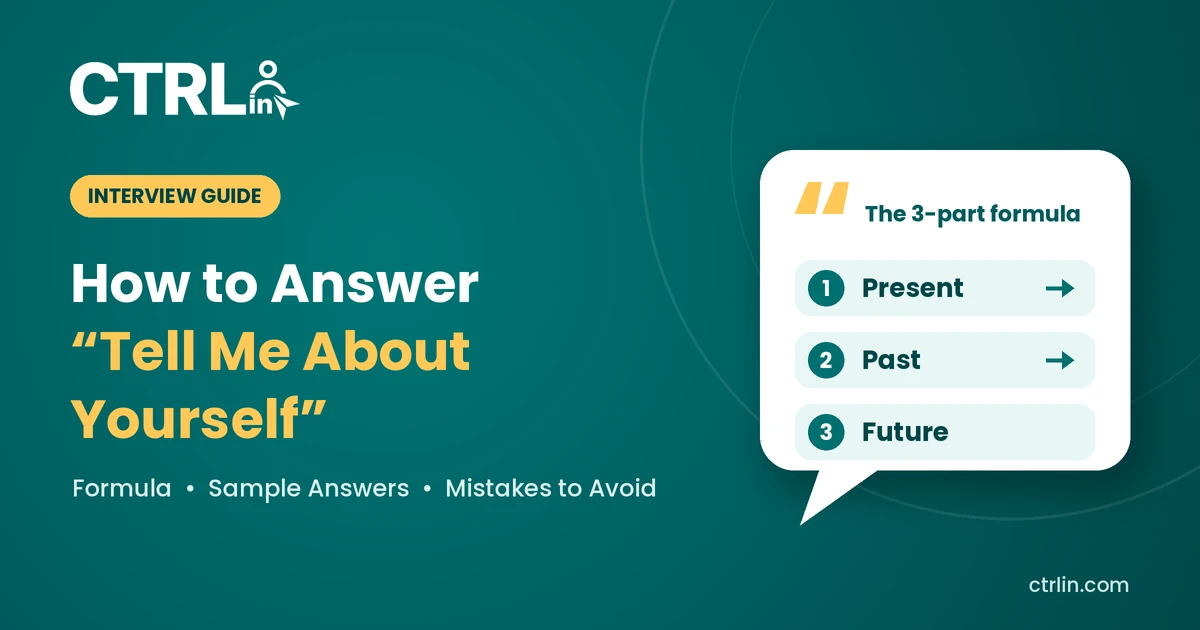
The Present-Past-Future formula is the easiest way to structure your answer. It keeps you focused, gives your story a clear flow, and ends on why you want this job.
- Present (20 to 30 seconds): Say what you do now. Mention your current role, your main responsibilities, and one achievement with a number if possible.
- Past (20 to 30 seconds): Explain how you got here. Pick one or two experiences, skills, or qualifications that are relevant to the new role.
- Future (15 to 20 seconds): Share where you want to go next and connect it to this company and position.
Freshers can flip the order to Past, Present, Future. Start with your education, move to internships or projects, and end with your career goals.
| Part | What to say | Example phrase |
| Present | Current role + one result | "I'm a digital marketer at XYZ, where I grew organic traffic by 40%." |
| Past | Relevant background | "Before that, I spent two years in content writing, which taught me SEO." |
| Future | Goal + why this role | "Now I want to lead a growth team, which is why this role excites me." |
How to Prepare Your Answer: 6 Steps
- Study the job description. Highlight the top three skills or qualities the employer wants. Your answer should prove you have them.
- Pick two or three highlights. Choose achievements, projects, or experiences that match those skills. Numbers make them memorable.
- Research the company. Learn its products, values, and recent news so you can explain why you want to work there.
- Write a rough script. Draft your answer using Present, Past, Future. Aim for 150 to 220 words.
- Practise out loud, then drop the script. Rehearse until you remember the key points, not the exact words. This keeps you sounding natural, not memorised.
- Record yourself and time it. Check your pace, filler words, and body language. Trim anything that pushes you past 2 minutes.
"Tell Me About Yourself" Sample Answers
Use these examples as a starting point. Replace the details with your own experience so your answer sounds authentic.
Sample Answer for Freshers
"I recently graduated with a Bachelor's in Computer Science from ABC University, where I focused on web development and databases. During my final year, I completed a three-month internship at a software house, building features for a client dashboard used by over 2,000 people. I also led a university project that won second place at a national hackathon. I enjoy solving real problems with clean, simple code. I'm now looking to start my career as a junior developer, and your team's focus on user-friendly products is exactly the kind of work I want to grow in."
Why it works: It turns limited work experience into proof of skill through an internship, a project, and a result.
Sample Answer for Experienced Professionals
"I'm currently a Senior Sales Executive at XYZ Solutions, where I manage 40 B2B accounts and exceeded my annual target by 25% last year. I started my career in customer support, which taught me how to listen to clients and understand their problems. That skill helped me move into sales, where I've built long-term relationships instead of one-time deals. Now I'm ready to take on a team lead role. Your company's expansion into new markets is a great opportunity for me to use my experience and help grow the team."
Why it works: It opens with a strong, measurable result and connects past experience to the next career step.
Sample Answer for a Career Change
"For the past five years, I've worked as a school teacher, where I designed lesson plans and explained complex topics to students of different levels. Over time, I found I enjoyed creating learning material the most, so I completed a certification in instructional design and built an online course that now has 500 learners. I'm now looking to move into corporate training full time. Your company's investment in employee development makes this role a natural fit for my skills and goals."
Why it works: It shows transferable skills and proves commitment to the new field with concrete steps.
7 Mistakes to Avoid
| Mistake | Why it hurts | Do this instead |
| Repeating your resume line by line | The interviewer has already read it | Tell the story behind 2 or 3 highlights |
| Sharing too much personal detail | Family, age, or hobbies rarely prove job fit | Keep it professional; add a hobby only if it is relevant |
| Talking for 5+ minutes | You lose attention and seem unfocused | Stay between 60 and 90 seconds |
| Being vague | "I'm hardworking" is forgettable | Back every claim with a result or number |
| Speaking negatively about past employers | It raises red flags about attitude | Focus on what you learned and where you're headed |
| Sounding memorised | Robotic answers feel insincere | Practise key points, not a word-for-word script |
| Using one answer for every job | Generic answers show low interest | Tailor your highlights to each role |
Extra Tips to Stand Out
- Start with a hook. Open with your strongest point, such as a result, a unique skill, or a clear passion for the field.
- Match the company's tone. A startup may welcome a relaxed style, while a bank or law firm expects a more formal answer.
- Show enthusiasm. Smile, keep steady eye contact, and let your interest in the role come through.
- End with a hand-off. Finish with a line like "That's why I'm excited about this role," so the interviewer knows you're done.
- In video interviews, look at the camera instead of the screen, test your audio first, and keep notes off screen so you don't read them.
- In phone interviews, your voice carries everything. Speak a little slower and smile while you talk; it changes your tone.
Frequently Asked Questions
How long should my answer to "Tell me about yourself" be?
Aim for 60 to 90 seconds, or about 150 to 220 words. Never go beyond 2 minutes.
Should I include personal information?
Keep the focus on your professional background. You can add one brief personal detail, like a hobby, only if it shows a skill relevant to the job.
How do freshers answer "Tell me about yourself"?
Freshers should talk about their education, internships, academic projects, and skills. Use the Past-Present-Future order and finish with your career goals.
Is "Tell me about yourself" the same as "Walk me through your resume"?
They are similar, but "Walk me through your resume" expects a more step-by-step overview of your jobs. "Tell me about yourself" is a shorter pitch focused on your best highlights.
Can I use the same answer for every interview?
Keep the same structure, but tailor the highlights and the future goal to each company and role.
What if I get nervous and forget my answer?
Remember just three keywords: one for present, one for past, one for future. They will guide you back even if you lose your place.
Conclusion
"Tell me about yourself" is your chance to make a strong first impression. Use the Present-Past-Future formula, back your claims with real results, and keep your answer between 60 and 90 seconds. Most importantly, connect your story to the job you want.
Prepare it once, practise it often, and adjust it for each role. When the question comes, you will be ready.
Preparing for your next interview? Explore more career guides and interview tips on Ctrlin, and share this post with a friend who has an interview coming up.
Get Exclusive Updates & Resume Builder Features
Subscribe to our newsletter and stay ahead with the newest tools, design updates, and job-winning tips.