How to Write a Resume with No Experience: A Complete Beginner’s Guide
10 Sept 2026 · CTRLin
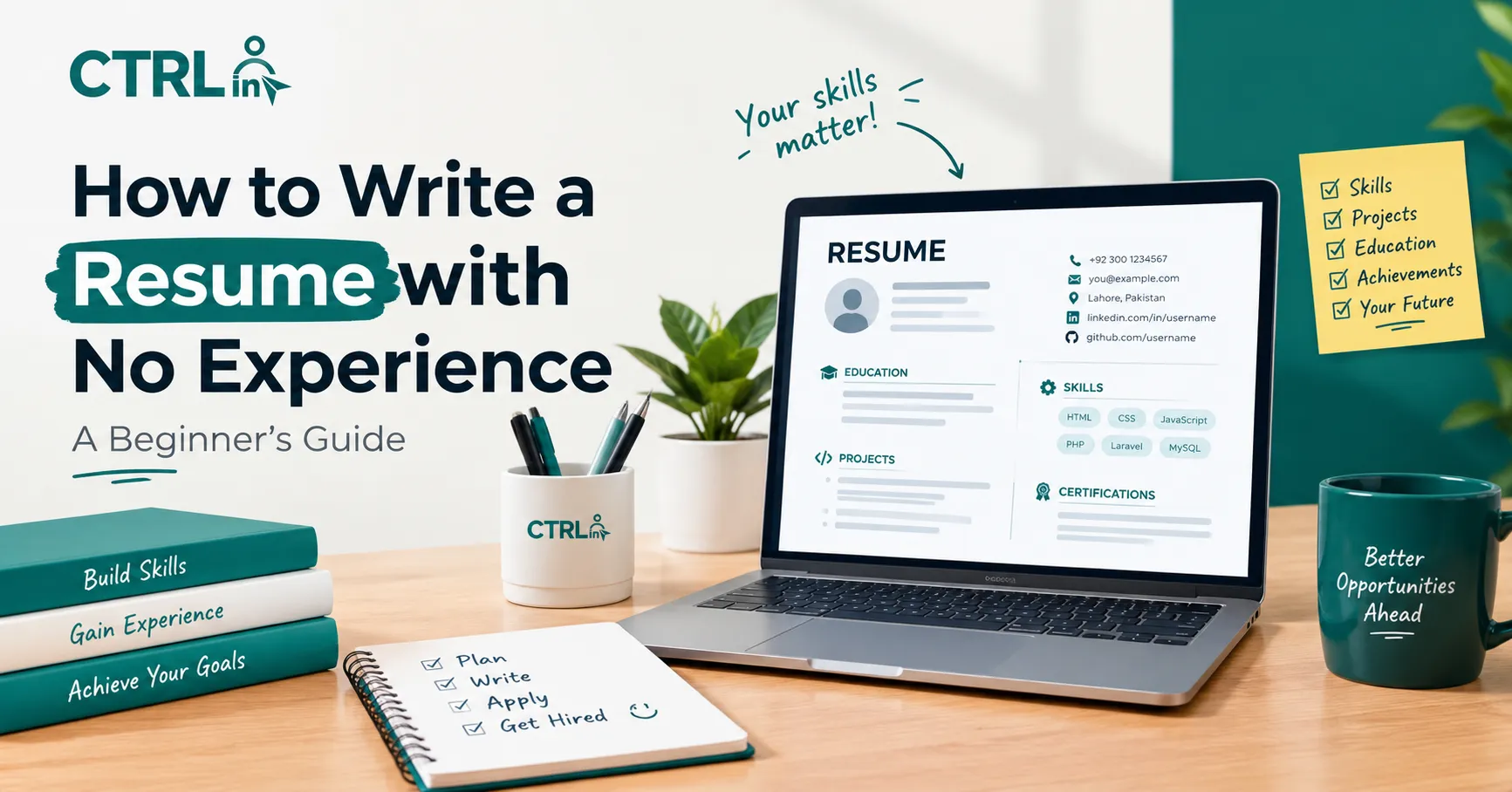
Writing your first resume can feel difficult when you have little or no professional experience. You may look at job postings asking for experience and wonder what you could possibly put on a resume.
The good news is that you do not need years of employment history to create a strong resume.
If you are a student, fresh graduate, recent career changer, or someone applying for your first job, you can build a professional resume by focusing on your skills, education, projects, internships, certifications, achievements, and relevant activities.
The key is not to make your resume look like you have experience you don't have. Instead, you need to show employers what you can do and what you are capable of learning.
In this guide, you'll learn how to write a resume with no experience, what sections to include, what to leave out, and how to make your first resume stand out.
Can You Write a Resume Without Work Experience?
Yes.
A resume is not simply a list of previous jobs. It is a summary of your qualifications, skills, education, projects, achievements, and experiences that are relevant to the position you want.
For example, a computer science graduate applying for a junior developer position may not have worked as a professional developer yet. However, they might have:
- Built websites or applications
- Completed university projects
- Created GitHub projects
- Completed programming courses
- Earned technical certifications
- Participated in coding competitions
- Completed an internship
- Worked on freelance projects
- Learned programming languages independently
These experiences can all help demonstrate your ability.
The goal of your first resume is to answer one important question:
Why should an employer consider you for this position?
What to Include on a Resume With No Experience
A beginner-friendly resume can include the following sections:
- Contact information
- Professional summary or objective
- Education
- Skills
- Projects
- Internships or volunteer experience
- Certifications
- Achievements and activities
- Relevant links
You do not need to include every section if it doesn't apply to you. Focus on the information that demonstrates your qualifications for the job.
1. Start With Your Contact Information
Place your basic contact information at the top of your resume.
Include:
- Full name
- Phone number
- Professional email address
- City and country
- LinkedIn profile
- Portfolio or personal website
- GitHub profile, if relevant
For example:
John Doe
Junior Software Developer
New York, USA
john.Doe@email.com
LinkedIn: linkedin.com/in/johnDoe
GitHub: github.com/john.Doe
Portfolio: johnDoe.dev
Make sure your email address looks professional.
An address such as coolboy123@email.com can make your resume appear less professional. A simple address using your name is usually a better choice.
2. Write a Strong Resume Summary or Objective
When you have no professional experience, your summary or objective becomes especially important.
It should quickly explain:
- Who you are
- What you have learned
- What type of role you want
- What skills you can bring to the employer
Avoid writing a generic statement such as:
"I am a hardworking person looking for a challenging job where I can grow."
Almost every applicant could write this.
Instead, make the statement specific.
Example for a Computer Science Graduate
Computer Science graduate with hands-on experience building web applications using PHP, Laravel, JavaScript, and MySQL through academic and personal projects. Seeking an entry-level software development role where I can apply my technical skills while continuing to grow as a developer.
Example for a Marketing Graduate
Recent marketing graduate with experience developing social media campaigns, conducting market research, and creating digital content through university projects and internships. Seeking an entry-level marketing role where I can contribute creative ideas and analytical skills.
Your summary should focus on evidence of your abilities, rather than simply describing your personality.
3. Highlight Your Education
If you have little or no work experience, your education can take a more prominent position on your resume.
Include:
- Degree
- University or college
- Graduation date
- Relevant coursework
- Academic achievements, if applicable
For example:
Bachelor of Computer Science
University of ABC
2026
Relevant coursework:
- Web Development
- Database Management
- Object-Oriented Programming
- Software Engineering
- Data Structures
You don't need to list every course you have taken.
Choose coursework that is relevant to the position you are applying for.
4. Turn Projects Into Experience
This is one of the most important strategies for writing a resume with no professional experience.
Projects can demonstrate practical experience even when you haven't worked for an employer yet.
For example, instead of simply writing:
Weather App
Explain what you actually did:
Weather Application
- Built a responsive weather application using JavaScript and a weather API.
- Implemented location-based weather searches and dynamic forecasts.
- Designed a mobile-friendly interface using HTML and CSS.
- Integrated API data and handled loading and error states.
This gives an employer something concrete to evaluate.
Projects Can Come From Many Places
Your projects could be:
- University assignments
- Final-year projects
- Personal projects
- GitHub projects
- Open-source contributions
- Freelance work
- Hackathons
- Coding challenges
- Design projects
- Research projects
For technical professionals, projects can be particularly valuable because they allow you to demonstrate skills that your employment history cannot yet show.
5. Add Internships and Volunteer Experience
An internship does not need to be a full-time job to be useful on your resume.
If you completed an internship, include:
- Company or organization
- Position
- Dates
- Responsibilities
- Achievements
For example:
Web Development Intern
ABC Technologies | June 2025 – August 2025
- Assisted developers with frontend development using HTML, CSS, and JavaScript.
- Fixed minor UI issues and tested website functionality.
- Participated in weekly development meetings.
- Assisted with database and content updates.
Volunteer work can also be useful when it demonstrates relevant skills.
For example, organizing a university event could demonstrate:
- Communication
- Teamwork
- Leadership
- Organization
- Problem solving
The important thing is to explain what you actually did, rather than simply listing the organization.
6. Create a Relevant Skills Section
Your skills section should match the position you're applying for.
For a junior software developer, this might include:
Technical Skills
- PHP
- Laravel
- JavaScript
- HTML
- CSS
- MySQL
- Git
- REST APIs
For a graphic designer:
Design Skills
- Adobe Photoshop
- Adobe Illustrator
- Figma
- UI Design
- Branding
- Typography
- Prototyping
Avoid filling your resume with dozens of skills just because you have seen them in job descriptions.
Only include skills you genuinely understand or have experience using.
7. Include Certifications
Certifications can help strengthen a resume when you don't have much employment history.
Relevant certifications might include:
- Google certifications
- Microsoft certifications
- AWS certifications
- HubSpot certifications
- Meta certifications
- Programming certifications
- Industry-specific courses
Include the certification name and issuing organization.
For example:
Google Data Analytics Professional Certificate
Google | 2026
Choose certifications that are relevant to the position you're applying for.
8. Add Achievements When They Strengthen Your Application
You may have more achievements than you realize.
Consider including:
- Academic awards
- Scholarships
- Coding competitions
- Hackathons
- University leadership
- Publications
- Speaking engagements
- Sports leadership
- Relevant competitions
- Open-source contributions
For example:
Achievements
- Finalist in a university-level software development competition.
- Built a student project selected for presentation at a technology event.
- Maintained a GitHub repository containing multiple personal web-development projects.
Only include achievements that strengthen your application.
9. Add Your LinkedIn, GitHub or Portfolio
If you don't have employment experience, your online professional presence can help provide additional evidence of your abilities.
For technology professionals, consider including:
- GitHub
- Personal portfolio
- Live project demonstrations
A developer's resume might say:
Built a task-management application using Laravel and MySQL.
A portfolio can then show:
- Screenshots
- Live demo
- GitHub repository
- Technology stack
- Project explanation
- Your specific contribution
This creates a stronger professional presentation than a resume alone.
10. Tailor Your Resume to Each Job
One of the biggest mistakes beginners make is creating one resume and sending it to every company.
Instead, read the job description carefully.
Identify:
- Required skills
- Preferred skills
- Responsibilities
- Tools and technologies
- Qualifications
- Important terminology
Then make sure your resume clearly demonstrates the relevant qualifications you actually possess.
For example, if a junior developer job emphasizes:
Laravel, MySQL, REST APIs and Git
and you have used all four in your projects, make those skills and projects easy to find.
Do not add technologies you have never used simply because they appear in the job description.
11. Use Action Words
Weak resume writing often describes responsibilities without showing contribution.
Instead of:
Responsible for creating a website.
Write:
Developed a responsive website using HTML, CSS and JavaScript.
Instead of:
Worked on a university application.
Write:
Built a student management application using PHP and MySQL.
Useful action words include:
- Built
- Developed
- Designed
- Created
- Implemented
- Improved
- Analyzed
- Managed
- Organized
- Tested
- Automated
- Collaborated
- Optimized
- Researched
Start bullet points with strong verbs whenever possible.
12. Focus on Results Where Possible
Even if you don't have professional experience, you can describe the outcome of your projects.
Compare:
Weak:
Created an e-commerce website using Laravel.
Stronger:
Developed a Laravel-based e-commerce application with product management, shopping cart, authentication, and order processing features.
Even better, when you have legitimate numbers:
Developed a Laravel-based e-commerce application supporting 500+ test products and automated order processing.
Numbers help employers understand the scale or impact of your work.
Never invent statistics just to make your resume look stronger.
13. Keep Your Resume Simple and Professional
Your first resume doesn't need complicated graphics or excessive design elements.
Use:
- Clear section headings
- Consistent formatting
- Readable fonts
- Appropriate spacing
- Short bullet points
- Consistent dates
- Simple visual hierarchy
For most entry-level applications, a clean and easy-to-read resume is safer than an overly decorative design.
Your content matters more than decorative elements.
How Long Should a No-Experience Resume Be?
For most students and fresh graduates, one page is usually enough.
You don't need to fill the page with unnecessary information.
If you have substantial projects, internships, certifications, or relevant experience, your resume may eventually become longer.
The goal should be:
Include enough information to demonstrate your qualifications without making the recruiter search for the important information.
Example Resume Structure for Someone With No Experience
A simple structure could look like this:
YOUR NAME
City, Country | Phone | Email | LinkedIn | Portfolio
PROFESSIONAL SUMMARY
2–4 sentences describing your education, relevant skills, projects, and target role.
EDUCATION
Bachelor of Computer Science
University Name | 2026
TECHNICAL SKILLS
PHP · Laravel · JavaScript · MySQL · Git · REST APIs
PROJECTS
E-Commerce Web Application
- Developed an e-commerce application using Laravel and MySQL.
- Implemented authentication, product management, cart, and order functionality.
- Integrated REST APIs for external services.
Task Management Application
- Built a responsive task-management application using JavaScript.
- Implemented task creation, editing, filtering, and status management.
CERTIFICATIONS
Certification Name — Issuing Organization
ACHIEVEMENTS
- Hackathon participant
- University project finalist
- Open-source contributor
Common Mistakes to Avoid
1. Saying "I Have No Experience"
Don't make your lack of employment experience the focus of your resume.
Instead of saying:
"I have no professional experience."
Show what you do have:
- Projects
- Education
- Skills
- Internships
- Certifications
- Achievements
2. Adding Fake Experience
Never create fictional jobs, companies, responsibilities, or achievements.
A strong entry-level resume can be built honestly.
3. Listing Too Many Skills
A long list of skills does not automatically make you qualified.
Prioritize skills that are:
- Relevant to the job
- Supported by your projects or education
- Skills you can confidently discuss in an interview
4. Using the Same Resume for Every Job
Different jobs emphasize different qualifications.
Tailor your resume to the position whenever possible.
5. Writing Long Paragraphs
Recruiters often scan resumes quickly.
Use short bullet points that communicate the most important information efficiently.
6. Using an Unprofessional Email Address
Your email address is part of your professional presentation.
Use something simple based on your name.
7. Including Irrelevant Personal Information
Avoid adding information simply to make your resume longer.
Focus on qualifications that help an employer evaluate your fit for the role.
How to Make a Resume With No Experience Stand Out
The strongest beginner resumes don't try to hide the fact that the applicant is new to the workforce.
Instead, they demonstrate potential.
Focus on these five areas:
1. Relevant Skills
Show what you can actually do.
2. Practical Projects
Demonstrate that you have applied your knowledge.
3. Education
Highlight relevant academic preparation.
4. Professional Presentation
Make your resume clean, organized, and easy to scan.
5. Career Direction
Make it clear what type of opportunity you are pursuing.
For technology professionals especially, combining a resume with a portfolio can give recruiters a better view of both your qualifications and your actual work.
Resume With No Experience: Final Checklist
Before submitting your resume, check the following:
- Your name and contact information are correct.
- Your email address is professional.
- Your resume has a clear target role.
- Your summary is specific to your career direction.
- Your education is easy to find.
- Your relevant skills are included.
- Your projects demonstrate practical abilities.
- Your internships or volunteer experience are included when relevant.
- Relevant certifications are listed.
- Your resume uses clear action verbs.
- Your information is truthful.
- Your resume is tailored to the job.
- Your formatting is consistent.
- Your resume is easy to scan.
- Your LinkedIn, GitHub, or portfolio links work.
- You have checked spelling and grammar.
Final Thoughts
Having no professional experience does not mean you have nothing valuable to put on a resume.
Your education, projects, technical skills, certifications, internships, volunteer work, achievements, and personal projects can all help demonstrate your potential.
The most important thing is to stop thinking of your resume as a list of jobs you've had.
Think of it as a professional presentation of what you can contribute.
For students and fresh graduates especially those entering technology careers a strong combination of resume + portfolio + professional profile can provide a much clearer picture of your abilities.
If you're starting from scratch, a resume builder can help you organize your information into a professional structure, choose an appropriate layout, and create a polished resume without spending hours formatting everything manually.
Your first resume doesn't need to prove that you have years of experience. It needs to show why you're ready for your next opportunity.
Get Exclusive Updates & Resume Builder Features
Subscribe to our newsletter and stay ahead with the newest tools, design updates, and job-winning tips.