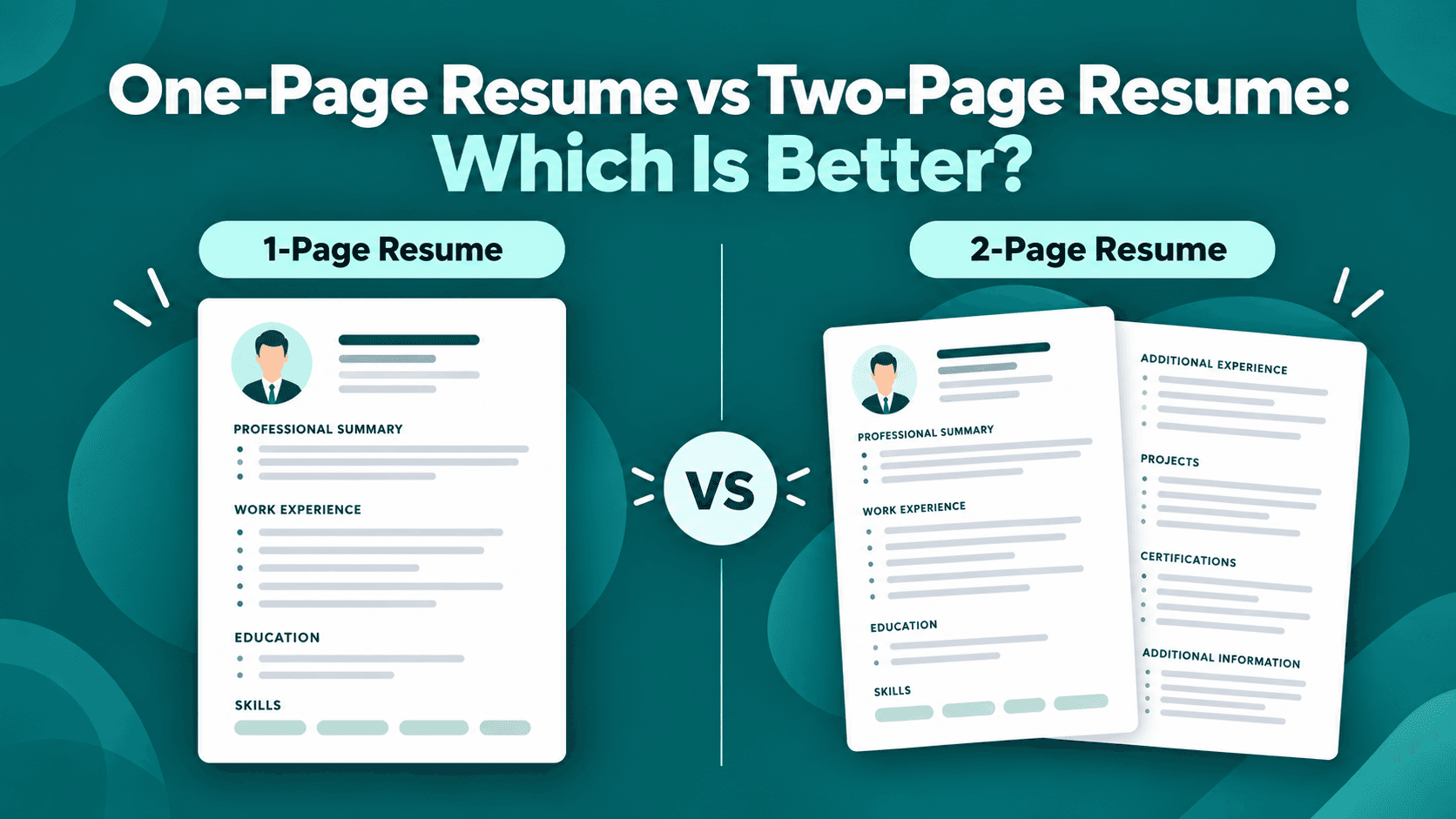
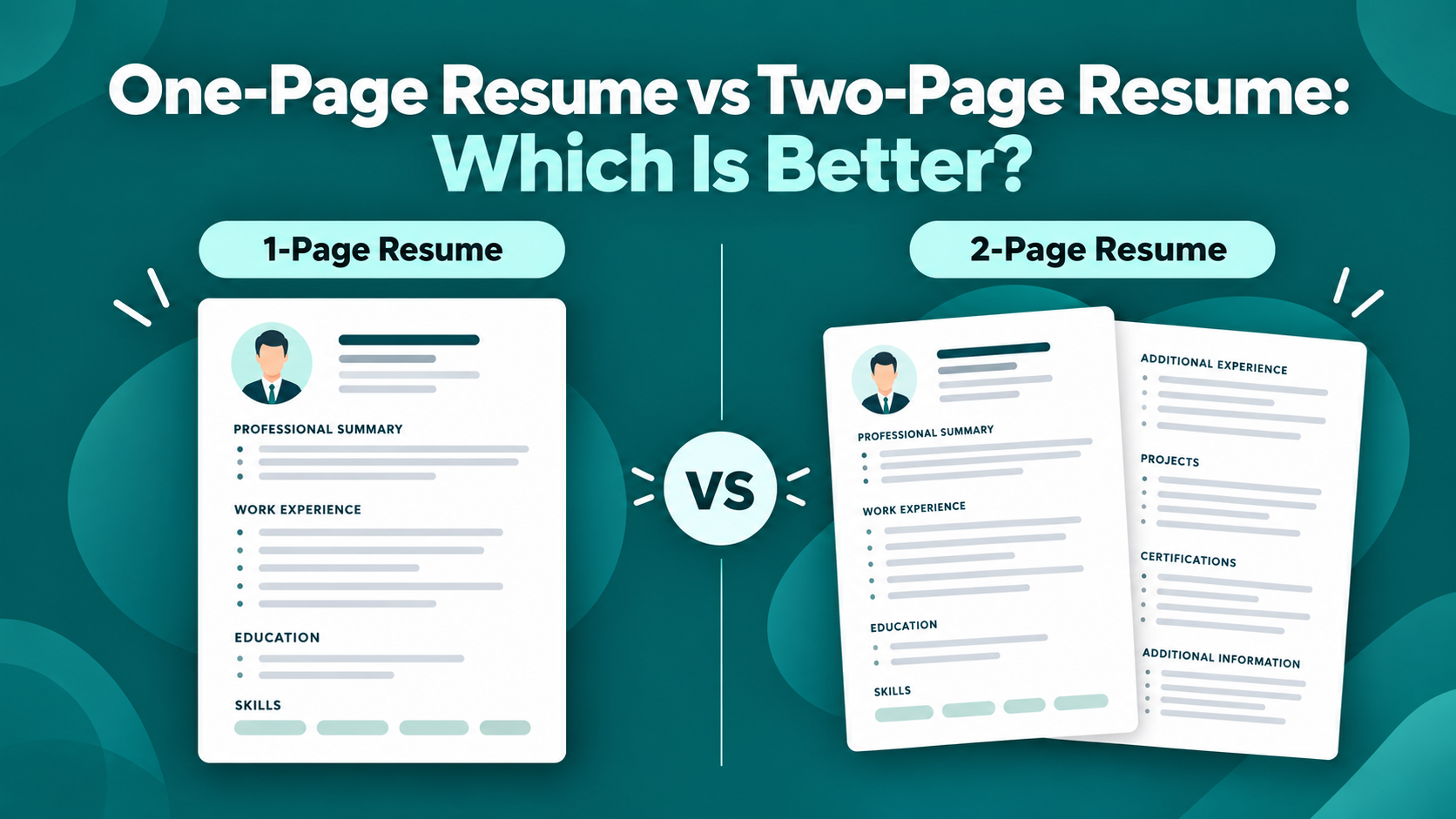
One-Page Resume vs Two-Page Resume: Which Is Better?
05 Oct 2026 · CTRLin
One of the most common questions job seekers ask when creating a resume is simple:
Should my resume be one page or two pages?
There is no universal rule that every resume must fit on a single page. The better choice depends on your experience, career level, industry, and—most importantly—whether the information you include is relevant to the job.
For students and recent graduates, a one-page resume is usually enough. For experienced professionals with a longer history of relevant achievements, a two-page resume can make more sense.
The goal is not to make your resume as short as possible. It is to make it clear, relevant, easy to scan, and convincing.
This guide explains the difference between a one-page and two-page resume, when to use each format, and how to decide which option is right for you.
One-Page Resume vs Two-Page Resume: Quick Answer
A one-page resume is generally better if you are:
- A student
- A recent graduate
- Applying for your first job
- An early-career professional
- Someone with limited relevant experience
- Changing careers and only some of your previous experience applies
A two-page resume may be better if you are:
- A mid-level professional
- A senior-level professional
- Someone with extensive relevant work experience
- Applying for a leadership or highly specialized position
- Someone whose important accomplishments cannot reasonably fit on one page
CareerOne Stop recommends keeping resumes to approximately one to two pages, using a second page when your level of experience makes it necessary.
So the real question is not:
“Is a one-page resume better?”
It is:
“How much space do I need to prove that I am a strong candidate?”
What Is a One-Page Resume?
A one-page resume presents your most relevant professional information on a single page.
It usually includes:
- Contact information
- Professional summary or objective
- Work experience
- Skills
- Education
- Certifications or projects when relevant
Because space is limited, every section needs to earn its place.
A good one-page resume does not tell your entire career story. Instead, it highlights the qualifications most relevant to the position you want.
That can make it particularly effective for recruiters who need to identify important information quickly.
What Is a Two-Page Resume?
A two-page resume gives you more room to explain your professional experience, accomplishments, skills, projects, certifications, and other relevant qualifications.
However, page two should not exist simply because you have more things to say.
It should contain information that genuinely strengthens your application.
Indeed's updated career guidance notes that two-page resumes can be appropriate for mid- and senior-level professionals, particularly when candidates have extensive relevant experience that cannot be presented clearly on one page.
A strong two-page resume might include:
Page 1
- Contact details
- Professional summary
- Core skills
- Most recent experience
- Major achievements
Page 2
- Additional relevant experience
- Projects
- Certifications
- Technical expertise
- Awards
- Education
- Professional development
Your strongest qualifications should still appear on the first page.
When Should You Use a One-Page Resume?
1. You Are a Student
Most students simply do not have enough relevant professional experience to justify two pages.
A strong student resume may include:
- Education
- Internships
- Academic projects
- Part-time work
- Volunteer experience
- Relevant skills
- Extracurricular activities
- Certifications
One well-organized page is normally enough.
University of Pennsylvania Career Services specifically recommends a one-page resume for undergraduate students and recent graduates.
2. You Are a Recent Graduate
If you have recently graduated, employers usually care more about the relevance of your experience than the amount of information you can provide.
For example, imagine you have:
- One internship
- Two university projects
- A bachelor's degree
- Several technical skills
- A professional certification
That information can normally be communicated effectively within one page.
Stretching it to two pages may simply introduce unnecessary information.
3. You Have Only a Few Years of Experience
An early-career professional may have worked at two or three companies but still be able to summarize the most important achievements on one page.
Consider this:
Weak version
Marketing Executive
ABC Company
- Responsible for social media.
- Responsible for email marketing.
- Worked with the marketing department.
- Prepared reports.
- Assisted with campaigns.
Stronger version
Marketing Executive
ABC Company
- Increased organic social engagement by 34% through a redesigned content strategy.
- Managed weekly email campaigns reaching 25,000+ subscribers.
- Supported product campaigns across social, email, and web channels.
- Built monthly performance reports using campaign and conversion data.
The stronger version tells employers much more without requiring additional space.
4. Much of Your Previous Experience Is Irrelevant
Suppose you worked in retail for four years before becoming a software developer.
If you are now applying for a frontend development position, you probably do not need several paragraphs explaining every retail responsibility you previously held.
You could instead give that older role one or two lines while giving more space to:
- Development experience
- Technical skills
- Projects
- GitHub work
- Framework knowledge
- Relevant certifications
Resume length should follow relevance—not simply the number of years you have been working.
When Should You Use a Two-Page Resume?
1. You Have Extensive Relevant Experience
A professional with 10 or more years of highly relevant experience may struggle to communicate their career effectively on one page.
Imagine a project manager who has:
- 12 years of experience
- Managed projects across several companies
- Led teams of 20+ employees
- Managed multimillion-dollar budgets
- Earned PMP certification
- Led major process improvements
- Delivered multiple high-value projects
Reducing all of that to one page could actually weaken the resume.
In situations like this, two pages can provide enough room to show career progression and measurable achievements.
2. You Are Applying for a Senior-Level Role
Executive and senior-management positions often require evidence of:
- Leadership
- Strategy
- Revenue growth
- Cost reduction
- Team management
- Transformation projects
- Business development
- Operational improvements
A hiring manager considering a senior candidate may need more context than can comfortably fit on one page.
Two pages are perfectly reasonable when both pages contain valuable evidence.
3. You Work in a Highly Technical Field
Technical professionals sometimes need additional space for specialized information.
For example, an experienced engineer may need to include:
- Engineering disciplines
- Major projects
- Software knowledge
- Certifications
- Technical systems
- Industry experience
- Project values
- Equipment knowledge
- Regulatory expertise
Similarly, an experienced software engineer may need to highlight:
- Programming languages
- Frameworks
- Cloud platforms
- Architecture experience
- Major systems
- Leadership experience
- Technical projects
Trying to squeeze everything into one page can make the document difficult to read.
4. You Have Important Projects, Certifications, or Achievements
Sometimes your job history itself fits on one page—but additional professional information makes a second page worthwhile.
Examples include:
- Major projects
- Patents
- Professional licenses
- Publications
- Awards
- Technical certifications
- Speaking engagements
- Professional memberships
The key word is relevant.
Having enough information to fill two pages does not automatically mean you should use two pages.
Does a Two-Page Resume Look Bad?
No.
A two-page resume does not automatically look unprofessional.
What looks bad is a two-page resume filled with unnecessary content.
For example, these details often add length without adding much value:
- Every job you have ever had
- Basic responsibilities instead of achievements
- Repetitive skills
- Very old experience
- Irrelevant certifications
- References
- Personal information
- Long paragraphs
- Generic career objectives
If your second page contains useful evidence of your qualifications, using two pages is completely reasonable.
Indeed similarly emphasizes that relevance and readability matter more than forcing all information onto a single page.
Does a One-Page Resume Look More Professional?
Not necessarily.
A one-page resume can look highly professional because it forces you to prioritize information.
But making a resume one page at all costs can create new problems.
For example, some candidates try to squeeze their resume onto one page by using:
- Tiny fonts
- Extremely narrow margins
- Almost no white space
- Dense paragraphs
- Multiple columns
- Excessive abbreviations
That may save space, but it makes the resume harder to read.
A clean two-page resume is often better than an overcrowded one-page resume.
Readability should always come first.
What About ATS? Is One Page Better?
Applicant Tracking Systems, or ATS platforms, are used by many employers to collect and process job applications.
Resume length by itself is usually not the main ATS concern.
Formatting matters more.
CareerOne Stop recommends simple layouts and notes that ATS systems may process straightforward formats more reliably.
An ATS-friendly resume should generally use:
- Clear section headings
- Standard fonts
- Simple formatting
- Relevant keywords
- Chronological work history
- Clearly written job titles
- Standard bullet points
Avoid making your resume visually complicated just to fit everything onto one page.
For example, reducing your font to 8 points and creating four tiny columns is not an improvement.
Keep the document readable for both software and humans.
One-Page vs Two-Page Resume by Career Level
| Career Level Recommended Length | |
| High school student | 1 page |
| College student | 1 page |
| Recent graduate | 1 page |
| Entry-level professional | 1 page |
| Early-career professional | Usually 1 page |
| Mid-level professional | 1–2 pages |
| Experienced specialist | 1–2 pages |
| Senior manager | Often 2 pages |
| Executive | Often 2 pages |
| Academic/research professional | May require 2+ pages or a CV |
These are guidelines—not strict rules.
Your content should determine the final length.
One-Page Resume Example
Imagine an entry-level UX designer applying for a junior role.
Their resume might contain:
Emma Johnson
Junior UX Designer
Summary
UX designer with internship experience creating user-focused web and mobile experiences using Figma, prototyping, user research, and usability testing.
Skills
Figma • Wireframing • Prototyping • User Research • Design Systems • Adobe XD
Experience
UX Design Intern — ABC Digital
- Created wireframes and prototypes for three client projects.
- Conducted usability testing with 20+ participants.
- Improved key checkout flows based on research findings.
Projects
Mobile Banking App Redesign
- Redesigned onboarding and navigation based on user research.
- Created interactive prototypes and usability test plans.
Education
BS Interaction Design
XYZ University
This candidate does not need a second page.
Their most relevant qualifications fit comfortably on one page.
Two-Page Resume Example
Now consider someone applying for a senior operations manager position.
They have 13 years of experience.
Page 1
Professional Summary
Operations leader with 13 years of experience managing manufacturing, supply-chain, and process-improvement initiatives across multinational organizations.
Key Skills
Operations Management • Supply Chain • Lean Manufacturing • Budget Management • Team Leadership • Process Improvement
Most Recent Experience
Operations Manager — ABC Industries
- Managed operations across three manufacturing facilities.
- Led a team of 65+ employees.
- Reduced operating costs by 18%.
- Improved on-time delivery from 82% to 96%.
- Managed annual departmental budgets exceeding $8 million.
Senior Operations Supervisor — XYZ Manufacturing
- Implemented Lean initiatives reducing production waste by 21%.
- Improved production output by 17%.
- Led cross-functional improvement projects.
Page 2
Previous relevant roles
Major projects
Professional certifications
Technical systems
Education
Awards
In this situation, page two helps demonstrate career depth instead of simply adding filler.
What Should Go on the First Page of a Two-Page Resume?
Your first page should contain your strongest selling points.
Recruiters should not need to reach page two before discovering why you are qualified.
Prioritize:
- Contact information
- Professional summary
- Key skills
- Most recent experience
- Strongest achievements
Page two should continue the story rather than introduce the important information for the first time.
Should You Put Your Name on the Second Page?
Yes.
If your resume has two pages, adding your name—and optionally a page number—to the second page can help keep the document identifiable.
For example:
Emma Johnson | Resume | Page 2
UPenn Career Services similarly recommends adding your name and page number when a resume extends beyond one page.
How to Shorten a Resume to One Page
If your resume is slightly longer than one page, do not immediately reduce the font size.
Start by improving the content.
Remove Irrelevant Experience
You do not need detailed descriptions of every job you have ever held.
Focus on positions that support your current application.
Reduce Old Experience
Older jobs can usually receive less space than recent positions.
Instead of:
Sales Assistant — ABC Store
- Helped customers.
- Organized shelves.
- Managed inventory.
- Operated checkout system.
- Answered customer questions.
- Assisted with stock deliveries.
You may simply write:
Sales Assistant — ABC Store | 2017–2019
Particularly if you are now applying for an unrelated professional role.
Remove Repetitive Bullet Points
If three jobs say:
- Communicated with customers
- Prepared reports
- Worked with teams
You are wasting valuable space.
Show progression instead.
Replace Responsibilities with Results
Compare:
Before
Responsible for managing social media accounts.
After
Grew social engagement by 42% within six months through targeted content campaigns.
The second version communicates much more value.
Remove Outdated Information
You usually do not need:
- Full street address
- References available upon request
- Every course you completed
- Basic computer skills
- Very old certifications
- High-school information once you have substantial higher education or professional experience
Keep Your Summary Short
Your professional summary should generally communicate your value in a few concise lines.
It should not become a biography.
When Should You Not Force Your Resume Onto One Page?
Do not force a resume onto one page when doing so requires you to:
- Remove important accomplishments
- Delete relevant experience
- Use unreadably small fonts
- Reduce margins excessively
- Eliminate necessary white space
- Compress everything into dense paragraphs
- Remove important projects or certifications
The purpose of your resume is to communicate your qualifications clearly.
Page count is secondary.
When Should You Avoid a Two-Page Resume?
Two pages are probably unnecessary when your second page contains only:
- Two additional bullet points
- An oversized education section
- References
- Hobbies unrelated to the job
- Generic skills
- Empty space
- Old or irrelevant positions
If page two exists mainly because of inefficient formatting, edit the resume first.
A nearly empty second page almost always indicates that the document can be improved.
One Page vs Two Pages: A Simple Test
Ask yourself these five questions.
1. Is everything on my resume relevant to the position?
If not, remove irrelevant information first.
2. Can I remove information without weakening my application?
If yes, shorten it.
3. Am I repeating similar responsibilities?
If yes, combine or remove them.
4. Would squeezing everything onto one page hurt readability?
If yes, use two pages.
5. Does the second page provide meaningful evidence of my qualifications?
If yes, keeping it is reasonable.
A good rule is:
Use one page when one page tells your story well. Use two pages when the second page makes your case stronger.
Common Resume-Length Mistakes
Mistake 1: Following the One-Page Rule Blindly
There is no universal rule requiring every professional resume to fit on one page.
Trying too hard to follow this rule can make experienced candidates remove their strongest accomplishments.
Mistake 2: Thinking More Pages Mean More Experience
A long resume does not automatically make someone look more qualified.
Recruiters care about relevance and impact.
Mistake 3: Adding Filler to Reach Two Pages
Never add extra content simply because you think senior professionals need two pages.
Your resume can still be one page if it communicates your qualifications effectively.
Mistake 4: Making the Font Tiny
Do not sacrifice readability just to achieve a certain page count.
Mistake 5: Giving Every Job Equal Space
Your most recent and relevant experience should usually receive the most attention.
A job from ten years ago rarely deserves as much space as your current position.
One-Page Resume vs Two-Page Resume: Which Is Better?
Neither format is automatically better.
The best resume is the shortest version that communicates your relevant qualifications clearly and convincingly.
Choose a one-page resume when:
- You are a student or recent graduate.
- You have limited professional experience.
- Your most relevant qualifications fit comfortably on one page.
- A second page would mostly contain filler.
Choose a two-page resume when:
- You have significant relevant experience.
- You are applying for mid-level, senior, or specialized positions.
- You need additional space for important achievements, projects, or certifications.
- Cutting the resume to one page would remove valuable information.
The strongest resume does not win because it has fewer pages.
It wins because every section helps an employer understand why you are a good fit for the job.
Final Thoughts
Resume length should never be treated as a competition.
A one-page resume is not automatically more impressive, and a two-page resume is not automatically too long.
Instead, focus on three things:
Relevance. Readability. Impact.
If your qualifications fit naturally on one page, keep them there.
If you genuinely need a second page to show relevant experience and achievements, use it confidently.
What matters most is that recruiters can quickly understand:
- What you do
- What skills you have
- What you have accomplished
- Why your experience matches the role
A well-structured resume that answers those questions will always be stronger than one that simply follows an arbitrary page-count rule.
Frequently Asked Questions
Is a two-page resume too long?
No. A two-page resume can be appropriate for experienced professionals when both pages contain relevant information.
Is a one-page resume better for ATS?
Not necessarily. ATS compatibility depends more on formatting, structure, keywords, and readability than page count.
Should a fresher have a two-page resume?
Usually not. Students, fresh graduates, and entry-level candidates can generally present their education, projects, skills, internships, and experience effectively on one page.
Is a one-and-a-half-page resume okay?
Technically yes, but it often indicates that the resume can be formatted more efficiently. If only a small amount of content appears on page two, try editing it down to one page. If substantial relevant content remains, format the document as a balanced two-page resume.
Should a resume ever be three pages?
For most corporate job applications, one or two pages are usually sufficient. Certain highly specialized, academic, research, medical, or executive backgrounds may require more detail. In academic environments, a curriculum vitae may also be more appropriate than a traditional resume.
Can I use two pages with less than 10 years of experience?
Yes. Years of experience are only a guideline. If you have substantial relevant projects, technical expertise, certifications, or achievements, a second page may still make sense.
What is the ideal resume length?
The ideal resume is long enough to demonstrate your qualifications but short enough to remain focused and easy to scan. For most job seekers, that means one or two pages.
Get Exclusive Updates & Resume Builder Features
Subscribe to our newsletter and stay ahead with the newest tools, design updates, and job-winning tips.