Resume vs CV: What’s the Difference? A Guide for Fresh Graduates
01 Aug 2026 · CTRLin
As a fresh graduate, applying for your first job can feel overwhelming. You may see employers asking for a resume in one job posting and a CV in another. Since both documents describe your education, skills, and experience, it is easy to assume they are the same.
As a fresh graduate, applying for your first job can feel overwhelming. You may see employers asking for a resume in one job posting and a CV in another. Since both documents describe your education, skills, and experience, it is easy to assume they are the same.
However, a resume and a CV are not always identical. They differ in their length, purpose, level of detail, and the situations in which they are used.
This guide explains the difference between a resume and a CV in simple terms and helps you understand which one you should use.
What Is a Resume?
A resume is a short and focused document that highlights the qualifications most relevant to a specific job.
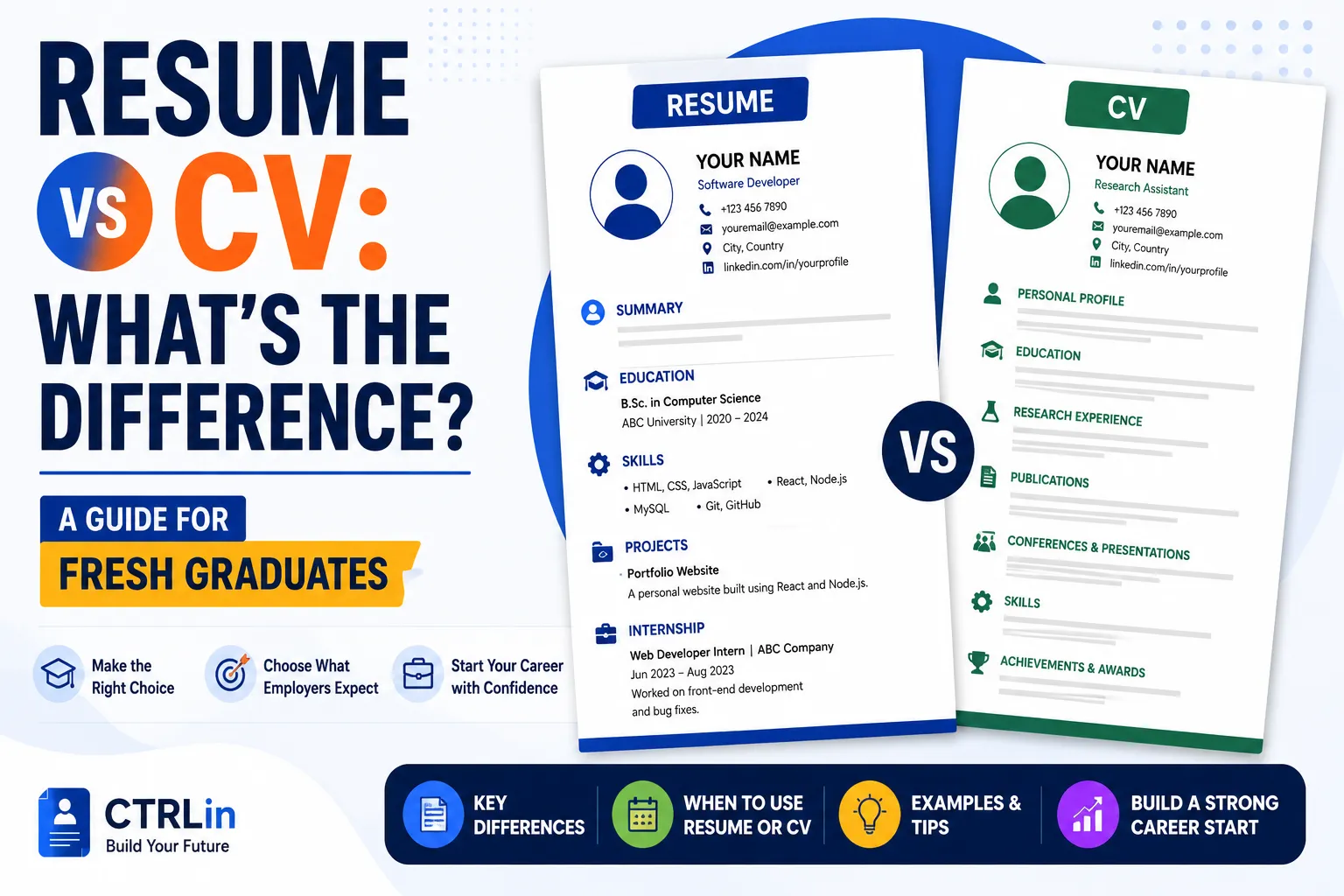
For fresh graduates, a resume usually includes:
- Contact information
- Professional summary or career objective
- Education
- Technical and soft skills
- Internships
- Academic projects
- Certifications
- Volunteer experience
- Achievements
A resume is usually one page long, especially if you are applying for your first job and have limited professional experience.
The purpose of a resume is to quickly show an employer why you are a suitable candidate for a particular role.
Example
If you are a Computer Science graduate applying for a junior web developer position, your resume may highlight:
- HTML, CSS, JavaScript, React, Laravel, or other relevant technologies
- Web development projects
- Internships
- GitHub projects
- Technical certifications
You would usually leave out information that is not relevant to the position.
What Is a CV?
CV stands for Curriculum Vitae, a Latin term meaning “course of life.”
A CV is generally a more detailed document that provides a complete overview of your academic and professional background.
A CV may include:
- Contact information
- Education history
- Research experience
- Publications
- Academic projects
- Teaching experience
- Conferences and presentations
- Scholarships and awards
- Certifications
- Professional memberships
- Research interests
In many countries, a CV is commonly used for academic, research, teaching, medical, or scientific positions.
Unlike a resume, a CV may be two or more pages long because it includes detailed information about your academic and professional journey.
Resume vs CV: Key Differences
| Feature Resume CV | ||
| Length | Usually 1 page for fresh graduates | Often 2 or more pages |
| Purpose | Job applications | Academic, research, or specialized roles |
| Content | Relevant skills and experience | Detailed academic and professional history |
| Customization | Usually tailored for each job | Often more comprehensive and consistent |
| Focus | Skills and qualifications for a specific role | Complete academic and career background |
| Common Use | Corporate and private-sector jobs | Universities, research institutions, and academic roles |
Which One Should Fresh Graduates Use?
For most entry-level jobs, fresh graduates should use a resume.
If you are applying for positions such as:
- Junior Web Developer
- Software Engineer
- Graphic Designer
- Marketing Executive
- HR Assistant
- Sales Executive
- Accountant
- Customer Support Representative
a concise, well-organized resume is usually the best choice.
However, you may need a CV if you are applying for:
- A university position
- A research program
- A scholarship
- A postgraduate degree
- A teaching role
- An academic internship
Always read the job description carefully. If the employer specifically requests a CV, submit a CV. If the employer asks for a resume, provide a resume.
Are Resume and CV the Same in Every Country?
No. The meaning of “CV” can vary depending on the country.
In the United States and Canada, a resume is generally used for most jobs, while a CV is mainly used for academic, research, and medical positions.
In the United Kingdom, Europe, Pakistan, and many other countries, employers may use the term CV when referring to the document used for regular job applications. In these regions, a CV may be similar to what is called a resume in the United States.
Because of these regional differences, it is important to check the employer’s requirements and the hiring practices in the country where you are applying.
How to Create a Strong Resume as a Fresh Graduate
Even if you do not have full-time work experience, you can still create an effective resume.
Focus on the qualifications that demonstrate your potential, such as:
1. Education
Include:
- Degree name
- University or college
- Graduation year
- Relevant coursework
- Academic achievements
2. Skills
Add skills related to the job you want.
For example, a fresh graduate applying for a web development role might include:
- HTML
- CSS
- JavaScript
- React
- Laravel
- MySQL
- Git
- Responsive web design
3. Academic or Personal Projects
Projects can demonstrate practical experience.
For each project, mention:
- Project name
- Technologies used
- Your responsibilities
- Key results or features
4. Internships and Training
Include internships, training programs, or practical work experience. Explain what you learned and the responsibilities you handled.
5. Certifications
Add relevant online courses and professional certifications, especially those connected to the role you are applying for.
6. Achievements and Activities
You can also include:
- Competitions
- Hackathons
- Volunteer work
- Leadership roles
- University societies
Common Mistakes to Avoid
Fresh graduates should avoid these common mistakes:
- Making the resume too long
- Adding irrelevant personal information
- Using complicated fonts or designs
- Including skills they cannot explain
- Writing long paragraphs
- Using the same resume for every job
- Forgetting to check spelling and grammar
- Adding an unprofessional email address
Keep your resume clear, relevant, and easy to scan.
Resume or CV: How to Choose
Use this simple rule:
Choose a resume when:
- You are applying for a regular job
- The employer asks for a resume
- You need a short and targeted document
- You are applying for an entry-level corporate role
Choose a CV when:
- You are applying for an academic or research role
- The employer specifically requests a CV
- You need to show detailed academic achievements
- You are applying for a scholarship or postgraduate program
Final Thoughts
For most fresh graduates, a resume is the right choice when applying for entry-level jobs. It should be concise, relevant, and tailored to the position.
A CV is usually more detailed and is commonly used for academic, research, teaching, or specialized opportunities. However, the meaning of “CV” can differ by country, so always check the employer’s requirements.
Your first resume does not need years of work experience to make a strong impression. Your education, skills, projects, internships, certifications, and achievements can show employers that you are ready to begin your career.
With CTRLin, you can create a professional, well-structured, and ATS-friendly resume that highlights your strengths and helps you apply for jobs with confidence.
Get Exclusive Updates & Resume Builder Features
Subscribe to our newsletter and stay ahead with the newest tools, design updates, and job-winning tips.