Common Resume Mistakes Students Make
07 Oct 2026 · CTRLin
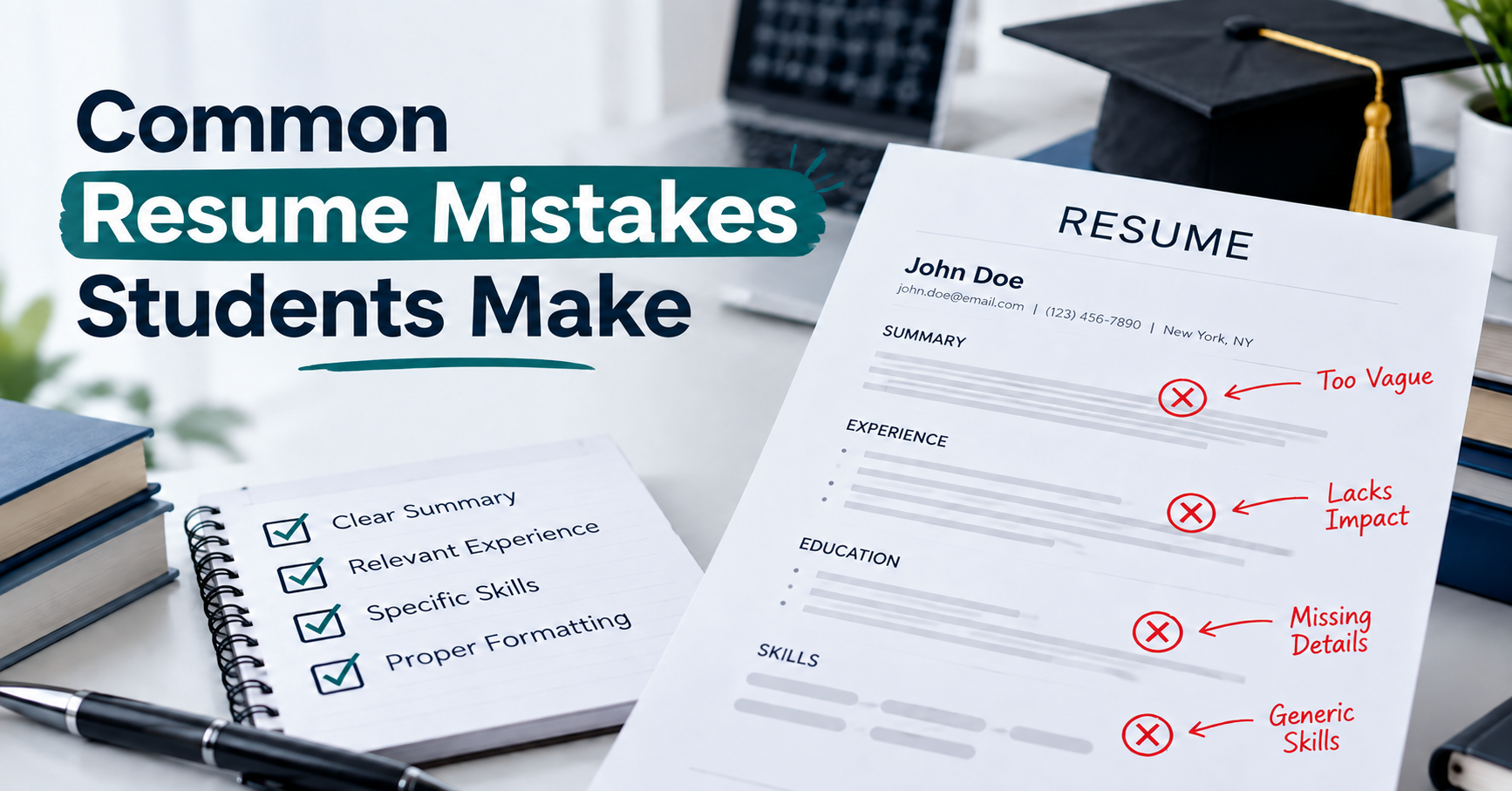
A student resume can underperform even when the candidate has useful skills, solid coursework, and relevant projects. The problem is often not a lack of experience. It is failing to present existing experience as clear evidence for the role.
Common resume mistakes students make include sending the same resume to every employer, listing duties instead of contributions, overlooking academic or extracurricular experience, using irrelevant content, and creating formatting that is harder for people or recruiting software to process.
These mistakes do not automatically cause rejection. Hiring decisions depend on the role, employer, applicant pool, and selection process. But weak relevance, unclear evidence, inaccurate claims, or difficult-to-read presentation can make it harder for recruiters and hiring managers to see why an applicant fits the position.
Treating Limited Experience as Having “No Experience”
A student without an industry job does not automatically have no experience. Academic projects, research, volunteering, student organizations, internships, independent work, part-time jobs, and relevant coursework can all provide credible evidence of skills.
The mistake is dismissing those experiences because they did not happen in a traditional full-time job.
What Actually Counts as Experience on a Student Resume
Experience deserves space on a student resume when it helps prove that you can perform relevant work.
NACE’s career-readiness framework identifies competencies such as communication, critical thinking, leadership, professionalism, teamwork, and technology. Those abilities can be demonstrated through many kinds of academic, extracurricular, and workplace activity, not only traditional employment. NACE Career Readiness Competencies
Consider a student who has:
- worked part time in a café;
- built an ecommerce website for a class;
- volunteered at a university event;
- served as treasurer of a student society.
The café role may demonstrate customer communication, reliability, problem-solving, and working under pressure.
The class project may demonstrate React, research, design, analysis, or teamwork.
The volunteer experience may demonstrate coordination and communication.
The treasurer role may demonstrate budgeting, record keeping, responsibility, and leadership.
An unrelated part-time job can stay when it provides stronger evidence of relevant transferable skills than the alternatives. Similarly, volunteering is worth including when it proves useful skills, responsibility, or outcomes that an internship-free student cannot demonstrate elsewhere.
Use this Experience Value Test before removing an activity:
- Did I solve a problem?
- Did I build, improve, research, or organize something?
- Did I work with customers, teammates, stakeholders, or participants?
- Did I use a skill relevant to the target role?
- Can I explain my individual contribution?
If the answer is yes, the experience may belong on the resume.
Relevant coursework can help too, especially early in university when projects and professional experience are limited. UPenn advises students to emphasize experiences that show relevant or transferable skills and allows relevant courses, awards, thesis work, and similar academic evidence within the education section. UPenn Resume Guidance
For a deeper walkthrough of building a first resume without formal employment, CTRLin has a dedicated no-experience guide. Resume With No Experience Guide
How to Decide What Deserves Space on the Resume
A student resume should not contain every project, class, job, club, and certificate you have completed. Use four criteria to decide what stays:
| Decision question | Keep the item when… |
| Is it relevant? | It connects to a responsibility, skill, or qualification in the target role |
| Is it evidence-based? | You can explain what you did, created, improved, or achieved |
| Is it recent enough? | It still represents your current level of capability |
| Is it distinctive? | It proves something that stronger items do not already prove |
Suppose a student applying for a frontend internship has:
- a React ecommerce application;
- a Python data-analysis assignment;
- a basic HTML tutorial project.
The React application deserves more space because it provides stronger evidence for the target role. The basic HTML project may be removable if the React project already proves those fundamentals at a higher level.
Coursework should be treated the same way. Do not fill the resume with every module you have completed. A short list of directly relevant courses is enough when those courses add knowledge that your projects or experience do not already prove.
For example:
Too broad
Relevant Coursework: Programming, Mathematics, Databases, Networking, Artificial Intelligence, Web Development, Algorithms, Software Engineering
More useful for a data internship
Relevant Coursework: Database Systems, Statistics, Machine Learning
If a project is highly relevant but needs screenshots, code, research detail, or a case study to demonstrate its value, summarize it on the resume and use a portfolio for the deeper evidence.
Sending the Same Resume to Every Internship or Job
Students usually do not need to rewrite their entire resume for every application. They do need to change what the resume emphasizes.
A targeted resume helps the employer see the relationship between your background and the specific role instead of asking the recruiter to make that connection for you.
What Students Should Actually Tailor for Each Application
Tailoring does not mean inventing experience or copying the job description. It means prioritizing truthful evidence according to what the employer needs.
For each application, review these five areas:
- Summary or headline, if you use one.
- Skills, especially technical or role-specific skills.
- Project order, with the most relevant work appearing earlier.
- Experience bullets, emphasizing the most relevant contributions.
- Terminology, when the employer’s wording accurately describes your experience.
Imagine a computer-science student with both a React project and a Python analytics project.
For a frontend internship, the React project may come first. Its bullets may emphasize responsive interfaces, APIs, component development, testing, and Git.
For a data internship, the Python project may move above it. The bullets may emphasize SQL, pandas, data cleaning, visualization, or statistical analysis.
The experience has not changed. Its priority has.
UPenn recommends organizing resume sections according to relevance and transferable skills rather than treating section order as fixed. UPenn Resume Guidance
The same principle applies to the skills section. You can reorder or select the most relevant genuine skills for each job, but you should never add a tool simply because it appears in the job description.
CTRLin also has a dedicated guide to tailoring resumes for individual applications. How to Tailor Your Resume for Every Job Application
A Fast Resume-Tailoring Workflow for Students
Resume tailoring can range from a quick relevance pass to a substantial rewrite. As a practical working estimate, a closely related role may require roughly 10 to 20 minutes of focused adjustments, while an application for a significantly different role may need much longer.
Treat that as a workflow estimate, not an industry rule.
Use this five-step process:
1. Read the job description for meaning.
Understand what the person will actually be expected to do.
2. Highlight the strongest requirements.
Look for repeated tools, skills, responsibilities, qualifications, and outcomes.
3. Mark what you genuinely match.
Do not try to manufacture a match for every requirement.
4. Connect each match to evidence.
Evidence may come from employment, coursework, projects, research, volunteering, or leadership.
5. Reorder and rewrite selectively.
Move the strongest evidence higher and adjust relevant wording.
A reusable professional profile can reduce repetitive work because your underlying education, projects, skills, and experience remain organized while each resume version changes its emphasis. CTRLin’s Resume Builder uses this profile-based workflow. CTRLin Resume Builder
Listing Responsibilities Instead of Showing Evidence of Impact
A responsibility tells the employer what you were assigned to do. An evidence-based bullet shows what you personally contributed, handled, created, or achieved.
Students do not need revenue figures or corporate KPIs to write strong bullets. They need specific evidence.
Responsibility vs Achievement: What Recruiters Need to See
Compare these examples:
Weak
Helped organize university events.
Stronger
Coordinated registration and logistics for three student events serving more than 250 attendees.
The first line describes an activity. The second shows scope and contribution.
Another example:
Weak
Worked on a mobile app with classmates.
Stronger
Built authentication and profile modules for a four-person mobile-app project using Flutter and Firebase.
The second bullet does not claim a business result the student did not have. It shows ownership, context, tools, and scope.
This approach aligns with NACE’s emphasis on observable career-readiness behaviors such as completing work, collaborating toward goals, communicating clearly, solving problems, and using technology effectively. NACE Career Readiness Competencies
How to Quantify Achievements When You Have No Business Metrics
Do not invent percentages, revenue, or performance improvements simply because generic resume advice says every bullet needs a number.
Students can quantify:
- team size;
- users or participants;
- events;
- survey responses;
- records or data points;
- pages or screens built;
- features developed;
- research participants;
- tests performed;
- deadlines;
- audience size;
- turnaround time;
- competition placement;
- project scope.
Use this structure:
Action + task + context + evidence or result
For example:
Before
Created a survey for a marketing project.
After
Designed and analyzed a 120-response student survey to identify three factors influencing campus food-delivery choices.
Another example:
Before
Helped create the website.
After
Built six responsive pages for a team ecommerce project using React and CSS, including product-search and checkout interfaces.
Not every strong bullet needs a number. When no meaningful metric exists, show complexity, ownership, tools, audience, output, or outcome instead.
Presenting Projects, Coursework, and Research Poorly
Projects are particularly valuable when paid employment does not yet demonstrate the skills required for a role.
A project entry should do more than name an assignment. It should explain what you created or investigated, what methods or tools you used, what you personally owned, and what evidence shows the project’s scope or outcome.
How to Turn a Class Project Into a Strong Resume Entry
A useful project entry answers four questions:
- What did you build, analyze, research, or improve?
- What tools or methods did you use?
- What did you personally contribute?
- What scope, result, or output can you show?
Software student
Campus Event Finder | React, Node.js, PostgreSQL
- Built responsive search and event-detail interfaces for a four-person final project.
- Integrated REST API data and filtering by category, date, and campus location.
- Wrote component tests for the project’s core search flow.
Marketing student
Local Café Campaign | University Marketing Project
- Developed a six-week social-media campaign using competitor research and audience surveys.
- Created a content calendar and five campaign concepts for students aged 18 to 24.
- Presented recommendations to the business owner and course panel.
Engineering student
Solar-Powered Irrigation Prototype | Team of 5
- Designed the sensor-mounting assembly using SolidWorks.
- Tested soil-moisture readings across three calibration ranges.
- Documented component selection and prototype results for the final technical report.
Academic research can also count as relevant experience when it supports the target role. Describe the research question, methodology, tools, sample or dataset, your own contribution, and the output.
CTRLin’s dedicated projects guide provides additional examples and project-format guidance. How to List Projects on a Resume
When a Project Needs a Portfolio Link
Add a portfolio link when seeing the work gives the employer useful evidence that a few resume bullets cannot provide.
A portfolio is especially useful for:
- software projects;
- UX or graphic design;
- marketing campaigns;
- writing samples;
- dashboards and analytics;
- engineering designs;
- research posters;
- photography or other creative work.
A developer may link a live application or repository. A designer may link a case study showing research, iterations, and final screens. A marketer may show campaign assets alongside performance analysis.
Do not link unfinished, private, broken, or irrelevant work merely to make the resume appear more substantial.
The resume should summarize. The portfolio should provide depth.
CTRLin’s Portfolio product is designed to display projects, case studies, and professional accomplishments when work needs more room than a resume can provide. Explore CTRLin Portfolios
Making ATS Mistakes With Formatting and Keywords
ATS stands for Applicant Tracking System. Employers use these systems to collect and manage applications, but there is no single universal ATS algorithm.
Different platforms and employers may use parsing, recruiter-defined filters, keyword searches, ranking or matching tools, and human review in different ways.
What ATS Actually Means for a Student Resume
An ATS can perform several different functions.
Parsing extracts information from a resume into structured candidate fields.
Search and filtering allow recruiters to find applications containing specified skills, titles, locations, qualifications, or other criteria.
Matching tools may help hiring teams compare applications against role-related criteria.
Greenhouse, for example, documents separate resume-parsing and keyword-filtering capabilities. Its Talent Filtering feature supports exact keyword searches across resume text and application information. Greenhouse: Unsuccessful Resume Parse
Current recruitment platforms may also include AI-assisted features. Greenhouse now offers AI-generated keyword suggestions based on job content and an assistive Talent Matching system that compares applications against recruiter-defined calibration criteria. Greenhouse explicitly states that its Talent Matching feature does not automatically advance or reject candidates. Greenhouse: Keyword Suggestions
The practical lesson is not to optimize for an imaginary universal ATS score.
Students can control:
- accurate information;
- relevant terminology;
- clear structure;
- machine-readable text;
- role alignment;
- appropriate keywords;
- evidence that supports the claims made.
Poor formatting can create parsing problems in some systems, but formatting alone does not universally trigger automatic rejection.
Formatting Choices That Can Cause Parsing or Readability Problems
A straightforward ATS-friendly resume template is a sensible default for most students applying through online recruiting systems. It reduces unnecessary formatting risk while keeping attention on qualifications.
Greenhouse’s own parser documentation identifies potential problems with:
- graphics, photos, or WordArt;
- image-based resumes;
- complex tables;
- headers and footers containing essential information;
- text boxes;
- columned layouts;
- unclear or inconsistent sections. Greenhouse: Unsuccessful Resume Parse
These are platform-specific documented risks, not proof that every ATS handles files identically.
A lower-risk resume therefore uses:
- clear section headings;
- selectable text;
- consistent date formatting;
- readable fonts;
- logical information hierarchy;
- contact information in normal document text;
- limited decorative elements.
Are two columns always bad? No. But some parsers document difficulties with columned layouts, so a single-column layout is a lower-risk choice when visual complexity adds little value.
Can tables cause problems? Yes, complex tables can create parsing problems in some systems. Avoid using them for essential resume information unless you have confirmed the output remains readable when parsed. Greenhouse: Unsuccessful Resume Parse
What about icons and skill bars? Do not make essential qualifications dependent on graphics. A visual bar showing “Python 80%” also gives the recruiter little useful context. Projects and experience provide better evidence.
What font size should students use? A standard readable body size around 10.5 to 12 points is a practical range supported by current University of Washington career guidance. University of Washington Resume Guidance
How many fonts should you use? One font family is the safest and simplest choice. A second font is rarely necessary. If you use two, keep their roles consistent, such as one for headings and one for body text.
Can you use color? Yes, restrained color is not automatically a problem. Maintain strong contrast and do not rely on color alone to communicate important information.
CTRLin’s Resume Builder offers structured templates with clear headings and readable typography, while its own ATS positioning correctly avoids guaranteeing performance across every recruiting system. CTRLin Resume Builder
For deeper ATS guidance, see CTRLin’s resume-keyword resource. Best Resume Keywords for ATS
How to Use Job-Description Keywords Without Keyword Stuffing
Use the job description as a relevance guide, not a vocabulary list to copy blindly.
Suppose an internship asks for:
- React;
- REST APIs;
- Git;
- responsive interfaces.
If you genuinely have those skills, surface them naturally.
Skills
React | JavaScript | REST APIs | Git | HTML | CSS
Project
Student Marketplace | React, REST API, Git
- Built responsive marketplace interfaces in React for desktop and mobile layouts.
- Integrated REST API endpoints for product search, authentication, and saved items.
- Managed feature branches through Git during a four-person project.
Greenhouse’s current Talent Filtering documentation shows that recruiters can search candidate application text for exact keywords and combine preferred or required terms. Greenhouse: Talent Filtering
That does not mean repeating a keyword ten times improves a resume.
Use job-description terminology when:
- you genuinely possess the skill or experience;
- the wording accurately describes what you did;
- you can support the claim through a project, role, course, certification, or other evidence.
If the posting asks for Tableau and you have never used Tableau, adding it just to create a keyword match misrepresents your background.
Keywords can appear naturally in:
- skills;
- experience;
- projects;
- certifications;
- summaries, when appropriate.
Evidence matters more than repetition.
Using the Wrong Resume Structure for Your Career Stage
A first-year student’s strongest evidence can be very different from a final-year student’s strongest evidence.
Resume structure should change as stronger experience becomes available. Section order is not a permanent rule.
Should Education or Experience Come First?
Put the section with the strongest relevant evidence earlier.
UPenn advises students to include degree information and expected graduation details while also organizing experience around relevance and transferable skills. Once students graduate, moving education below experience is a standard option when professional experience has become stronger. UPenn Resume Guidance
For example:
First-year student with no internship
Education → Skills → Projects → Experience/Activities
Final-year student with two relevant internships
Experience → Projects → Skills → Education
These are examples, not universal templates.
A first-year student applying for a research position may still lead with education or research. A final-year student with a highly relevant internship may benefit from leading with experience.
How Your Resume Should Change From First Year to Graduation
Your resume should gradually replace older or weaker evidence as better university-level evidence becomes available.
| Career stage | Usually prioritize | Usually phase out |
| First year | Education, strong school achievements, early projects, activities, part-time work | Little if university evidence is still limited |
| Middle years | College projects, student leadership, research, internships, technical skills | Weaker high-school activities |
| Final year | Relevant internships, substantial projects, research, leadership, achievements | Most school-level filler |
| Fresh graduate | Role-relevant experience, projects, achievements, professional or technical skills | Content included only because you were a student |
A first-year student can keep a strong high-school achievement when it is still one of the best examples of leadership, technical ability, competition success, or responsibility.
By final year, that same item usually loses value if university projects, internships, research, or leadership demonstrate the same capability more recently.
Use this decision rule:
Replace older evidence when newer evidence proves the same skill more strongly.
Students who later need to decide between a resume and a CV can use CTRLin’s fresh-graduate comparison guide. Resume vs CV: A Guide for Fresh Graduates
Expected Graduation Date and Coursework: What Belongs
If you are still studying, include an expected graduation date so employers can understand your academic timeline.
UPenn specifically recommends including the degree, program, and expected graduation date. UPenn Resume Guidance
A simple format works:
BSc Computer Science, University Name
Expected May 2027
Relevant coursework can help when it provides useful information that is not already obvious from your degree, projects, or experience.
For example:
Relevant Coursework: Database Systems, Machine Learning, Statistics
Avoid turning the education section into a transcript.
A practical rule is to include only a short selection of courses that are directly relevant to the role and add evidence that stronger sections do not already provide.
Once substantial projects, internships, or research prove the same capabilities, reduce or remove the coursework list.
Keeping Irrelevant Content and Forcing Everything Onto the Page
A one-page resume is often practical for students, but one page is not an absolute rule.
The more useful question is whether each line contributes relevant evidence.
University of Washington career guidance describes resumes as typically one to two pages, with one page sufficient for many industry applications. University of Washington Resume Guidance
What to Remove When a Student Resume Is Too Long
If the document feels crowded, do not start by shrinking the font.
Cut content in this order:
1. Duplicated evidence
If three basic projects prove the same HTML skill, keep the strongest one.
2. Old, irrelevant material
Replace weaker high-school content as better university evidence develops.
3. Generic coursework
Remove courses that add nothing beyond your degree title or projects.
4. Weak projects
Keep projects that demonstrate target-role skills, not every assignment you have completed.
5. Low-value bullets
Remove statements that describe obvious duties without adding evidence.
6. Decorative filler
Remove unnecessary objective statements, reference lines, graphics, or other space-consuming material.
A second page is not automatically a resume mistake. Students with substantial research, publications, internships, technical projects, or other relevant evidence may legitimately need additional space.
Do not ask only:
Can I force this resume to one page?
Ask:
Does every item help the employer evaluate my fit for this role?
For a deeper career-stage treatment, CTRLin also has a guide to resume length. How Long Should a Resume Be?
Small Professionalism Mistakes That Create Avoidable Friction
Professionalism includes accurate contact information, working links, consistent dates, readable formatting, and application details that do not contradict one another.
These details cannot compensate for weak experience, but they can prevent avoidable confusion.
Contact Details, References, and Consistency
Before sending a resume, check:
- professional email address;
- correct phone number;
- working LinkedIn and portfolio links;
- accurate education details;
- consistent job titles;
- consistent dates;
- correct spelling of employers and organizations.
A straightforward email address based on your name is usually the safest professional choice.
References normally do not belong on the resume unless the employer specifically asks for them. UPenn’s current resume guidance tells students to save references until they are requested. UPenn Resume Guidance
The phrase “References available upon request” is therefore unnecessary in most applications.
LinkedIn does not need to copy your resume word for word. It may contain additional projects, activities, descriptions, and detail.
However, major facts should remain consistent. If your resume says an internship ended in July while LinkedIn says October, that discrepancy creates a question that did not need to exist.
Your resume, LinkedIn profile, portfolio, and cover letter can emphasize different information while sharing the same underlying facts.
Student Gaps Do Not Need to Be Treated Like Executive Career Gaps
A semester without paid employment does not automatically require explanation on a student resume.
Students may have periods devoted to:
- full-time study;
- family responsibilities;
- health or personal circumstances;
- degree changes;
- travel;
- examinations;
- caregiving;
- job searching.
If the timeline does not create an obvious issue, you may not need to explain anything.
If clarification is genuinely useful, keep it factual and brief.
For example:
Family Caregiving | Sep 2025–Jan 2026
Provided full-time family support while continuing online coursework.
That level of detail may be appropriate when the gap would otherwise create confusion and the context is something you choose to disclose.
In other cases, the resume is not the best place for explanation. A cover letter can provide short context when the information is relevant to the application but does not belong in an experience bullet.
Do not account for every month since high school. Explain only what helps the employer understand your application accurately.
A Student Resume Should Support the Rest of the Application
A resume summarizes relevant evidence. It cannot always show the full depth of a project, explain motivation for a particular employer, or present every example that supports a skill.
Different application assets have different jobs.
| Asset | Main purpose |
| Resume | Summarize relevant education, skills, experience, projects, and achievements |
| Portfolio | Demonstrate selected work in greater depth |
| Cover letter | Add role-specific context, motivation, and explanation |
| Professional profile | Keep core career information organized and consistent |
A designer can mention a UX project on the resume and use a portfolio to show research, wireframes, iterations, and final screens.
A developer can summarize a React application on the resume and link to a live demo or repository.
A student changing direction can use a cover letter to explain why the target role makes sense without turning the resume into a personal essay.
Dates, titles, project facts, qualifications, and achievements should not conflict across these assets.
CTRLin connects its Resume, Portfolio, and Cover Letter workflows through a shared professional profile, which can reduce inconsistency when the same education, skills, projects, and experience are reused across multiple career assets. CTRLin Resume Builder
Use additional assets only when they solve a real application problem. A student applying for an accounting internship does not need to create a portfolio simply because the option exists.
Student Resume Mistake Checklist Before You Apply
Use this checklist before submitting an internship, graduate-job, or entry-level application.
Content
- ☐ Does every major section provide information relevant to the role?
- ☐ Have I replaced vague duties with specific contributions where possible?
- ☐ Do projects explain what I personally did?
- ☐ Are important skills supported by evidence?
- ☐ Have I removed weak or repetitive projects?
- ☐ Have I kept useful part-time, volunteer, research, or leadership experience?
Targeting
- ☐ Is this version tailored to the target role?
- ☐ Are the most relevant projects and experiences easy to find?
- ☐ Have I used job-description terminology only where it truthfully matches my background?
- ☐ Are relevant skills prioritized?
ATS and Readability
- ☐ Are section headings clear?
- ☐ Is essential information written as selectable text?
- ☐ Is contact information outside graphics, headers, or complex text boxes?
- ☐ Is the layout easy to follow?
- ☐ Are unnecessary tables, charts, or skill bars removed?
- ☐ Is body text comfortably readable?
- ☐ Have I used one consistent font family, or a clearly controlled second font if necessary?
Student-Specific Details
- ☐ Is my expected graduation date clear if I am still studying?
- ☐ Have I replaced outdated high-school content where stronger university evidence exists?
- ☐ Does coursework still add useful information?
- ☐ Have I used projects, research, volunteering, or activities to fill genuine evidence gaps?
Professionalism
- ☐ Is my email address professional?
- ☐ Do all links work?
- ☐ Are dates, titles, and qualifications accurate?
- ☐ Are major facts consistent with LinkedIn and other application materials?
- ☐ Have I removed unnecessary reference statements?
- ☐ Have I proofread the final document?
CTRLin also provides a broader pre-application resume checklist for candidates who want another final review before submitting. Resume Checklist Before Applying for a Job
What Should You Fix First If Your Resume Has Several Problems?
Fix the problems that affect truth, relevance, and evidence before spending time on cosmetic changes.
Use this order:
1. Accuracy
Remove claims, skills, dates, qualifications, or metrics you cannot support.
2. Relevance
Remove low-value material and identify the experiences that best match the target role.
3. Evidence
Strengthen vague duties, activities, and projects so they show what you actually contributed.
4. Targeting
Adjust project order, skills, bullets, and terminology for the application.
5. Structure
Place your strongest evidence where it is easiest to find.
6. ATS and readability
Reduce avoidable parsing risks and make the document straightforward for a human reader.
7. Polish
Fix grammar, spelling, broken links, file naming, spacing, and visual inconsistencies.
A student resume does not fail simply because it lacks a sophisticated design. The more important question is whether a recruiter or hiring manager can understand what you can contribute to this particular role and see credible evidence supporting that conclusion.
Once your resume communicates that clearly, stop polishing it indefinitely. Submit the application and continue strengthening the underlying evidence through projects, research, internships, work, and other relevant experiences.
FAQ
Is having no internship experience a problem on a student resume?
Not having an internship does not mean you have nothing useful to show. Use projects, research, volunteering, part-time work, student leadership, and relevant coursework when they demonstrate skills needed for the role. Prioritize the experiences that provide the strongest evidence rather than creating an empty experience section simply because you have not completed an internship.
Should students put GPA on a resume?
A GPA is not automatically required unless the employer asks for it. It can support an early-career application when academic performance is particularly relevant or strong, but conventions vary by field and employer. Follow the application instructions first and avoid treating GPA as a substitute for projects, experience, skills, or other evidence.
Should students use a resume or a CV?
The answer depends on the country and application type. In many US industry applications, employers request a concise resume. Academic, research, and some international applications may use a CV with much more detail. Fresh graduates should follow the terminology and document requirements in the specific application. CTRLin’s resume-versus-CV guide explains the distinction in more depth. Resume vs CV Guide
Should a student put a photo on a resume?
There is no universal international rule. In the United States, photos are generally not standard on resumes, while practices can differ in other countries and industries. Follow local hiring conventions and the employer’s instructions rather than applying one country’s resume rules everywhere.
Do I need a portfolio if I have no work experience?
Not every student needs one. A portfolio is most useful when work can be demonstrated directly, such as software, design, marketing, writing, analytics, engineering projects, or other case-based work. If a resume already provides enough evidence for the role, a portfolio may add little. If employers need to see the work itself, it becomes more valuable.
Should developers put GitHub on a student resume?
A GitHub link can help when the repositories support the role and are organized well enough for someone else to review. Do not add GitHub simply because you are a developer. Relevant, documented projects are more useful than an inactive profile filled with incomplete tutorial repositories.
Should students write a cover letter if it is optional?
An optional cover letter can be useful when you have meaningful context the resume cannot communicate well, such as strong motivation for the organization, a career transition, a relevant story behind your experience, or a connection between unusual experience and the role. It adds less value when it simply repeats resume bullets.
Should a cover letter repeat the resume?
No. The resume summarizes evidence, while the cover letter should connect selected evidence to the specific employer and role. Use the letter to explain relevance, motivation, or context rather than turning resume bullets into paragraphs. CTRLin’s Cover Letter Builder is designed around this complementary workflow. CTRLin Cover Letter Builder
Can ATS automatically reject my resume because it has the wrong formatting?
Formatting can cause parsing problems in some systems, but there is no universal rule that one formatting choice automatically causes rejection everywhere. Some ATS platforms document difficulty with complex tables, image-based resumes, headers, footers, and columned layouts. Use clear, readable structure and follow the employer’s requested file format. Greenhouse: Unsuccessful Resume Parse
Do AI hiring tools mean I should write my resume differently?
You should still optimize for truthful relevance, clarity, and evidence rather than trying to manipulate an AI system. Some modern recruiting platforms use AI-assisted keyword suggestions or candidate matching, but implementations vary. Greenhouse, for example, describes its Talent Matching feature as assistive AI and states that recruiters and hiring managers remain responsible for hiring decisions. Greenhouse: Talent Matching
Should I explain a gap semester on my resume?
Not automatically. A semester without paid work can be normal for a student. Explain it only when the timeline would otherwise be confusing or the context materially helps the application. If explanation is needed, keep it brief and factual. A cover letter may be more appropriate when the context requires more than one line.
How long should it take to tailor a student resume?
There is no fixed industry standard. A closely related role may need only a short 10-to-20-minute relevance pass, while a substantially different role may require deeper rewriting. Focus on matching the most important requirements with genuine evidence instead of changing every sentence for every application.
Ready to turn your education, projects, skills, and experience into a clearer application-ready resume? CTRLin’s Resume Builder lets you organize your professional information, choose a structured template, preview the result, and download your completed resume as a PDF. Build Your Resume With CTRLin
Get Exclusive Updates & Resume Builder Features
Subscribe to our newsletter and stay ahead with the newest tools, design updates, and job-winning tips.